Smith Mountain Lake Shoreline & Dock Permits: AEP, Corps & County
Before anyone sets stone, drives a piling or cuts a tree along your Smith Mountain Lake shoreline, a permit is usually involved, and for riprap it's three. Appalachian Power (AEP) manages the shoreline under its federal license, the U.S. Army Corps of Engineers signs off on riprap and dredging, and Bedford, Franklin or Pittsylvania County handles erosion and building permits. This guide takes each permit in the order you'll need it, lists the work that needs none, explains the spring spawning limits, and covers what happens to your permits when the house sells.
Quick reference: which permit for which job
| The job | What it takes |
|---|---|
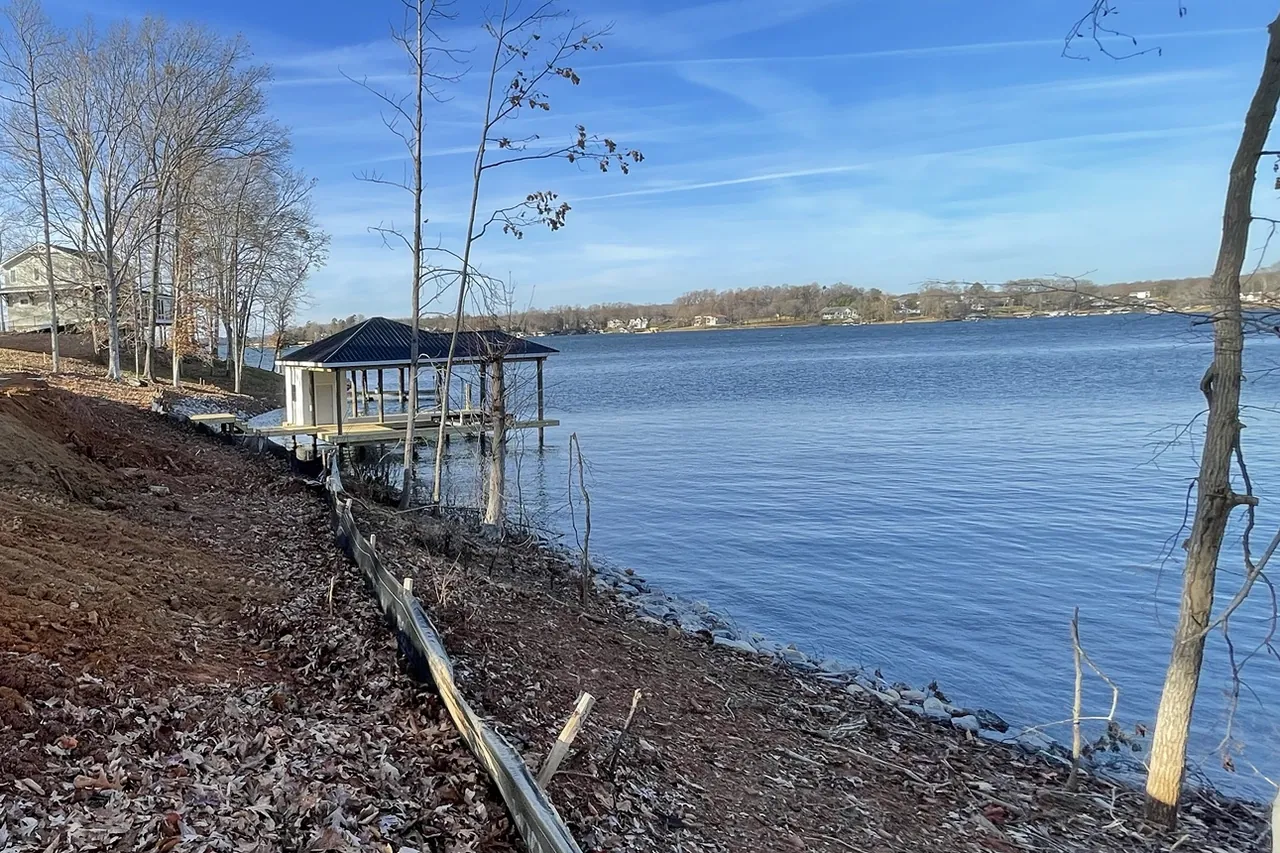
| New riprap or other shoreline stabilization | Corps permit first, then AEP's Shoreline Stabilization Permit, then the county erosion and sediment control permit, with copies sent back to AEP. |
| Resetting existing riprap within its original footprint | No AEP permit. Adding stone needs one. |
| A new or larger dock, boathouse, stairs or path below 800 feet | AEP Occupancy and Use Permit, then a county building permit. |
| New decking, siding, shingles or stain, same size and spot | No AEP permit, unless the county requires one. |
| A new or expanded PWC lift | AEP approval. |
| Mooring whips on an existing dock | No AEP approval. |
| A retractable boat cover | A permit only if it reaches past the dock, overhangs included. |
| Dredging silt | AEP and Corps permits; never February 15 to June 15. |
| A bulkhead or seawall | Prohibited unless FERC grants a variance. |
| Cutting trees or brush | Nothing for stems under ½ inch, pruning or limited thinning; for more, ask AEP about a Vegetation Removal Permit. |
| A buoy | Virginia Department of Wildlife Resources and Coast Guard approval. |
| Selling, or deeding to a trust or LLC | Formally assign the Occupancy and Use and any Non-Commercial permits to the new owner. |
AEP charges no permit fee. The paperwork costs are the county clerk's recording fee for a dock permit, the county's own permit fees, and the surveyor.
The two lines every permit uses: 795 and 800 feet
Full pond is 795 feet above sea level, which AEP calls the base elevation, and shoreline length for dock sizing is measured along it. The Project boundary is the 800-foot contour. Everything below 800 feet is part of the Smith Mountain Project, which AEP manages under its license from the Federal Energy Regulatory Commission (FERC), and FERC has authority over that boundary. On a gentle lawn, five feet of rise can reach well up the yard; on a steep bank it may be a few steps.
The water rarely sits exactly at 795. AEP says normal operations can move the lake up to 2 feet, and it drops further when inflow is low; in the 2026 drought it sat about five feet below full pond for months (WSET, October 13, 2026). The rules measure from fixed contours, not from the waterline you see.
Riprap and shoreline stabilization, step by step
This is the permit with the strictest order. AEP won't authorize the work until the Corps permit exists, and AEP's permit isn't valid until the county permit comes back.
- Check that the bank qualifies. AEP's FAQ asks owners to try vegetation first, then bioengineering (plants combined with structure), and only then hard armor such as riprap, which may be allowed where erosion is active: bare ground, undercut or sloughing banks, or spots that can wash sediment into the lake.
- Apply to the Corps through its online Regulatory Request System. Questions about that permit go to the Corps directly.
- Complete AEP's Shoreline Stabilization Permit application (updated May 21, 2026): a site plan with the 800-foot boundary, the 795-foot base elevation, shoreline length, and property and extended property lines; a plan view and cross-section with all dimensions; stone type, slope and toe depth; whether filter fabric is used and whether the work is done from land or water; and the Corps permit.
- Get every owner's signature. All owners of record sign. A contractor or agent can't sign for you, though your contractor can be listed on the form. Wrong signatures or missing information send the application back.
- Mail it to AEP Shoreline Management. AEP visits the site once it arrives.
- Take the AEP permit to the county for its erosion and sediment control (E&S) permit.
- Send copies of the approved county permits to AEP. Until then, AEP's permit isn't valid.
- Build to the permit. Erosion controls go in before clearing or grading, bare soil is stabilized within seven days of final grade, and trees pulled out for the stone are bundled and sunk along the nearby shoreline in water no deeper than 15 feet.
If bundling and sinking doesn't apply, or equipment needs extra clearing to get in, a Vegetation Removal Permit may be needed too. The stone and slope specs are in the riprap guide.
County erosion and sediment permits
Each county draws its own line, and two of the three are stricter near water:
- Bedford County (the north half of the lake): a Land Disturbing Permit for disturbance over 10,000 square feet, or within 200 feet of a body of water at any size. An acre or more also needs state VPDES construction permit coverage.
- Franklin County (most of the south shore): the county says its ordinance requires permitting for land disturbance "3,000 square feet or greater and within 200 feet of surface water." Single-family lots can use an agreement in lieu of a plan.
- Pittsylvania County (a small part of the lake, including the dam access): a permit to disturb more than 10,000 square feet, through the Community Development Department. Its page doesn't mention a waterfront rule and exempts disturbances under 10,000 square feet, so ask Community Development whether a smaller riprap job needs anything from the county for AEP's file.
AEP's forms also list Campbell County, because the same plan covers Leesville Lake. Since AEP's permit hinges on the county's, call the county before deciding a small job is exempt.
Docks, stairs and paths: the Occupancy and Use Permit
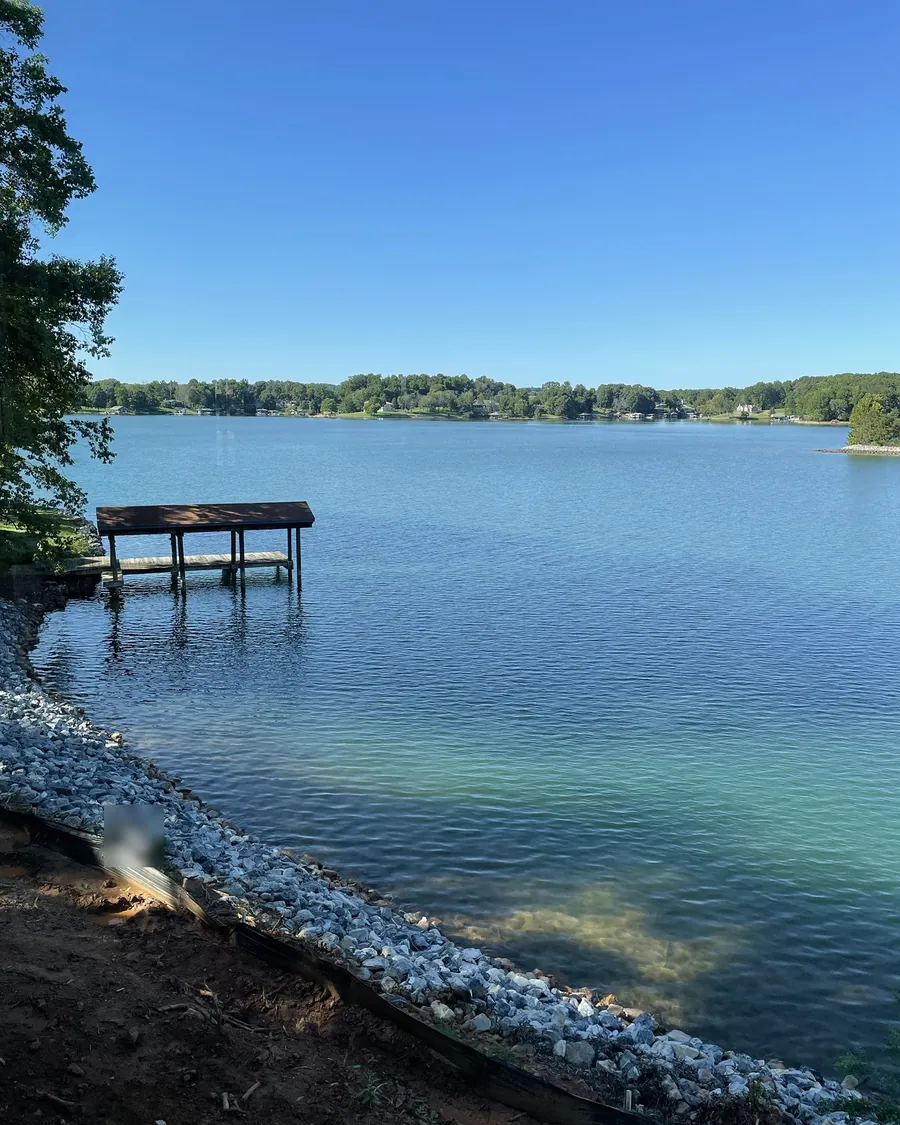
A dock, boathouse, landing, stairway or path inside the Project boundary needs an AEP Occupancy and Use Permit, and AEP is clear that it is not a building permit. AEP issues its permit if the plan meets the Shoreline Management Plan; you take copies to the county for the building permit; copies of the county's approval go back to AEP to make its permit valid. Construction must be finished within two years of issue.
The single-family application (updated July 31, 2026) asks for:
- A surveyor's drawing of the existing and proposed structure, which the form says must come from a licensed surveyor: dimensions, height and roof overhang, the 800- and 795-foot lines, shoreline length, property and dock delineation lines with distances, enclosed area, slips, total square footage, distance across the cove, and the distance to the nearest lateral mark and to adjacent structures.
- Property records: tax map and parcel number, deed book and page, and the recorded subdivision plat. A GIS printout from the county website doesn't count.
- A blank Occupancy and Use Permit signed by the deeded owners and notarized. The application's signature page needs no notary.
- A recording-fee check to the county's Clerk of the Circuit Court.
- When they apply: an oversized boat slip acknowledgement form for any slip longer than 26 feet, existing and proposed conditions on the survey for an expansion, and, for lots under 100 feet of shoreline, proof the lot existed before September 2, 2003.
Recording fees listed on AEP's application
| County | Fee and payee |
|---|---|
| Bedford | $48, Clerk of the Circuit Court of Bedford County |
| Franklin | $43, Clerk of the Circuit Court of Franklin County |
| Pittsylvania | $48, Clerk of the Circuit Court of Pittsylvania County |
| Campbell | $43, Clerk of the Circuit Court of Campbell County |
Stairs to the water must be at least 30 feet from other structures, no more than 6 feet wide, and 15 feet in from extended property or dock delineation lines. Paths can be no wider than 6 feet and should run straight down to the shore where the ground allows. Dock sizes and heights are on the new docks page.
What needs no AEP permit
- Rearranging existing riprap without going past its original length, width or height.
- Replacing a dock's surface materials, siding, roof shingles and sheathing, with no change to its dimensions, configuration or location.
- Painting or staining dock surfaces.
- Adding mooring whips to an existing dock.
- A boat cover that stays within the dock's footprint, overhangs included.
- Removing plants under ½ inch in diameter; pruning, though not topping; and thinning or limbing trees by up to 20 percent of the canopy or 14 feet, whichever is less, keeping the tree healthy.
- Mowing a lawn cleared before August 31, 2003, if nothing but grass grows there.
Two cautions. AEP's dock application says routine maintenance needs no AEP permit "unless a county permit is required," so ask the county building office before structural repairs. And anything that adds size or a new structure goes back to AEP. Dock repair sorts out where that line falls.
Dredging
Silt around a dock can come out only under permits from both AEP and the Corps. Only accumulated sediment may be removed, nothing in wetlands, nothing from February 15 through June 15, none within 10 feet (measured horizontally) of the 795-foot contour, and none between the 793- and 795-foot contours. Those last two keep a dredge off the shallow fringe along the bank.
Trees, beaches and stormwater below the 800-foot line
- Trees and shrubs. Vegetation removed to install erosion control must be replaced or mitigated under Table 2.5-2 of the plan, or offset with fish habitat structures. Other removal goes through the Vegetation Removal Permit.
- Fallen trees in the water. AEP discourages removing submerged woody debris unless it's a navigation or safety hazard, and pulling it without approval can mean an after-the-fact permit and mitigation.
- Beaches. New beaches are prohibited outside Public Use areas with a FERC variance. A beach that existed before August 31, 2003 can be kept up but not enlarged, sand can't go on a natural beach, and no sand goes below 795 feet.
- Stormwater. Structures that discharge stormwater straight into the Project boundary aren't allowed.
Spring limits: February 15 to June 15, and April 15 to June 15
Under a 2007 FERC order cited in the plan, in-water construction is prohibited from February 15 through June 15 in shoreline identified as Conservation/Environmental or Impact Minimization Zone. Elsewhere it's allowed, but from April 15 through June 15 AEP needs extra information to protect largemouth bass nests.
For that window, the 2007 order calls for a written report on the site before spring construction: the type of bottom material, the exact location on the lake, photographs, and any visible signs of nests. AEP's current dock application flags the same April 15 to June 15 window for extra precaution. If a nest turns up, the job can be changed or held until after June 15. Ask Shoreline Management which classification your shoreline has before picking a spring start.
The 30-foot setback from Resource Protection Areas
AEP's 2025 plan classifies about 52.3 miles of the lake's shoreline, roughly 10 percent, as Resource Protection Area. Low Density Use, the heading for single-family dock rules, covers 372.1 miles, or 73.2 percent. Structures beside RPA shoreline, shoreline stabilization included, must stay 30 feet from the edge of the RPA classification, so RPA frontage next door can decide where your dock or stone goes.
Bulkheads and seawalls
Bulkheads are prohibited unless FERC grants a variance under section 3.4.1 of the plan, and AEP says variances are approved only in limited situations where other methods won't work. The published rules don't say what repairs are allowed on an existing wall, so ask Shoreline Management first. Seawalls and bulkheads covers the options.
When the lake house sells
AEP permits don't pass to a buyer on their own. Occupancy and Use Permits and Non-Commercial Permits must be formally assigned to the new owner by application, including a transfer into a trust or an LLC, and an unassigned permit can be revoked. Assignments are recorded with the county's Clerk of the Circuit Court; AEP's assignment application for Non-Commercial permits (updated July 6, 2026) lists $48 in Bedford and Pittsylvania and $43 in Franklin and Campbell. AEP's permit site has a separate path for assignments.
Buying? Ask the seller for every AEP permit on the lot and whether the dock is a legacy dock (built before August 31, 2003 and unmodified since, or never given an Occupancy and Use Permit), since legacy docks carry their own rebuilding conditions.
Where the counties fit: Va. Code § 15.2-1226
Va. Code § 15.2-1226 lets Bedford, Franklin and Pittsylvania "regulate the land of their respective counties in and around Smith Mountain Lake below the 800-foot contour concerning the location, size, and length of wharves, piers, boathouses, docks, bulkheads, and similar structures to provide for safe navigation of the lake." A county ordinance can't conflict with the Uniform Statewide Building Code or with AEP's rights under its federal license; it may set approval procedures and penalties; and the counties may act jointly. So beyond AEP's permit, plan on the county building permit and any dock rules your county has adopted.
Appeals and AEP contacts
An appeal of an AEP decision goes in writing to the Hydro Plant Manager, Appalachian Power Company, P.O. Box 2021, Roanoke, VA 24022, and can also go to FERC. For everything else:
- Phone: AEP Shoreline Management, 540-985-2579
- Email: shorelinemanagement@aep.com
- Mail: Appalachian Power Company, Shoreline Management, P.O. Box 2021, Roanoke, VA 24022-2121
- Forms: smithmtn.com/shoreline/permits
- The Shoreline Management Plan: smithmountainproject.com
Permit questions
Can a contractor sign the AEP application for the owner?
No. The shoreline form needs every owner of record, and the dock form needs the deeded owners, with their signatures on the permit notarized. A contractor can prepare the drawings and the Corps request, but the signatures are yours.
How long does an AEP shoreline permit take?
AEP's FAQ gives no review time. In the SML Insiders' Guide (updated January 1, 2026), one dock builder called AEP permitting a big part of a 12- to 15-month lead time. Riprap adds the Corps step first, and incomplete packages come back, so a complete one is the fastest.
Can a contractor do in-water work in May?
Not in Conservation/Environmental or Impact Minimization Zone shoreline. Elsewhere, yes, with the bass-nest information filed, and the job may be adjusted if a nest is found. Dredging is off everywhere until June 15.
Does a contractor need a permit just to reset riprap that's already there?
Not from AEP, if the stone stays within its original length, width and height. Once new stone is added, the full Corps, AEP and county sequence applies.
How this site helps
Call (540) 410-1330 or send a request, and we'll connect you with one independent local contractor who works on the lake and can go over the permits for your lot. Contractors are responsible for their own licensing, insurance, permits, pricing and warranties, and you sign the AEP application yourself.
Related pages
Sources
- AEP Shoreline Management FAQs
- AEP Shoreline Stabilization Permit application (updated 5/21/2026)
- AEP Occupancy and Use Permit application, low density single-family docks (updated 7/31/2026)
- AEP application for assignment of a Non-Commercial permit (updated 7/6/2026)
- AEP Vegetation Removal Permit application (updated 5/21/2026)
- AEP Shoreline Management Plan (FERC-approved February 18, 2025)
- U.S. Army Corps of Engineers Regulatory Request System
- Va. Code § 15.2-1226
- Bedford County residential land disturbance
- Franklin County Erosion & Stormwater Management
- Pittsylvania County Land Disturbance
Planning shoreline or dock work on the lake?
Tell us where your property is and what you have in mind, and we'll pass it to one independent local contractor.