Dock Repair on Smith Mountain Lake, VA
Soft boards, a tired roof, a piling that's started to lean: when your Smith Mountain Lake dock needs repair, the first question is whether the job needs AEP's permission, and only then what it costs. Some repairs need nothing from AEP, and some count as changing the structure. This page sorts the two, explains what applies to legacy docks built before August 31, 2003, covers reflectors and the dock-wiring safety concern on the lake, and gives national repair costs with sources.
Repairs that need no AEP permit
AEP's FAQ answers "What shoreline/dock maintenance can I do without a permit?" with a short list:
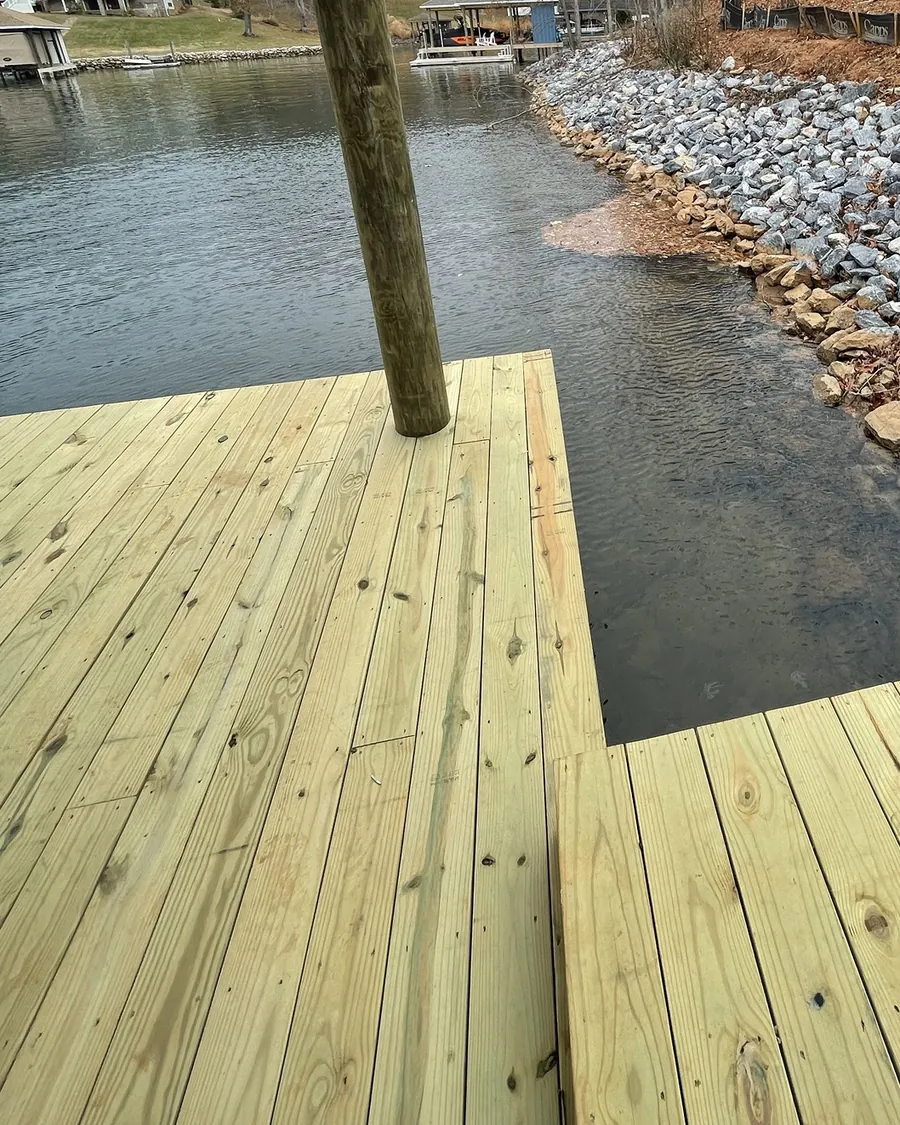
- Replacing surface materials, siding, roof shingles and sheathing, as long as nothing changes in the dimensions, configuration or location of the dock or the structure you use to reach it.
- Painting and staining dock surfaces.
That covers new deck boards on the existing frame, new siding on an enclosure, a new roof surface over the same roof, and a fresh coat of stain. AEP's dock application adds one condition: routine maintenance needs no AEP permit "unless a county permit is required." Before a re-roof or anything structural, call the building office in your county (Bedford, Franklin or Pittsylvania) and ask whether it needs a permit.
Repairs that go back to AEP
The FAQ is just as direct on the other side: "any new structure or modification which expands a structure requires approval from Appalachian Power." A repair that also widens the walkway, lengthens the dock, adds a slip or a PWC lift, encloses more space, or swaps a pitched roof for an upper sundeck is a change to the structure, not maintenance. Upper sundecks are allowed in place of a pitched roof, but no roof can be added above one.
Then there's the gray zone. AEP's no-permit list names surface materials, siding, shingles, sheathing and paint. It doesn't mention pilings, framing, floats or the walkway's structure, and AEP's dock application describes routine maintenance as work with "no new pilings." If the repair replaces structural parts, even in the same spot, ask Shoreline Management (540-985-2579, shorelinemanagement@aep.com) before the work starts, and keep the answer.
Some things can't be added during a repair at all. Sinks, showers and other sanitation facilities aren't allowed on docks or anywhere in the Project boundary, and a dock enclosure can't have plumbing or be lived in.
Legacy docks built before August 31, 2003
AEP's legacy program covers docks built before August 31, 2003 that haven't been modified since the Shoreline Management Plan took effect or never received an Occupancy and Use Permit. Legacy applications are accepted at any time but must be complete, and AEP says certain conditions apply, including construction and permit timelines.
The terms printed on AEP's dock application explain what that means for a rebuild:
- Docks and piers may be replaced "under certain circumstances," which the application points to section 2.7 a. of the plan to define.
- Walkways wider than the plan allows, and enclosures bigger than it allows, can't be replaced or rebuilt.
- A replacement goes inside the buildable area as far as possible, and keeps a 30-foot setback near Resource Protection Area shoreline.
- Structures other than docks or piers inside the Project boundary can't be replaced.
- A replacement structure can't include habitation or sanitation facilities.
So with an older dock that needs more than surface work, the question is what AEP will let it become, not just what the fix costs. Get that answer before agreeing to a rebuild price.
Reflectors
Occupancy and Use Permits issued on or after August 31, 2003 require white reflectors along the outer edges of the dock every 20 feet, and final approval depends on them. They're easy to lose when boards or fascia are replaced, so put them on the repair list. As a quick check, 100 feet of outer edge means a reflector at least every 20 feet, or five to six.
Dock wiring and stray current
The SML Insiders' Guide (Jerry Hale, February 27, 2025, updated January 1, 2026) reports that a drowning caused by stray electrical current in the water drew new attention to dock wiring. The three shoreline counties have adopted wiring and grounding standards for new dock construction, and an electrical contractor quoted in the article urges owners to make sure their docks comply.
A dock contractor quoted in the same piece points out that those standards aren't required for existing structures, and recommends continuous stray-voltage monitoring, because a single reading can change when a neighbor lowers a lift cradle into the water or flips a circuit. He put one monitoring system at about $1,500 installed. If your dock has power and you're already planning repairs, it's a sensible time to have an electrician check the wiring and grounding. Until that's done, keep swimmers away from a powered dock.
Licensing matters here. Virginia's Marine Facility Contracting specialty "does not provide for the construction of accessory structures or electrical, HVAC, or plumbing functions" (18VAC50-22-30), so the wiring calls for an electrical contractor, not the dock builder's marine license.
Use low water to look underneath
During the 2026 drought the lake sat about five feet below full pond for months (WSET, October 13, 2026), so more of each piling and the bank under the walkway was out of the water than usual. Photos from that stretch are worth keeping: rotted or cracked pilings, loose bracing, hardware rusted through, and washed-out ground where the walkway meets the shore. They give a contractor something concrete to quote from. Low water covers what else the drawdown exposed.
What dock repair costs
HomeAdvisor's 2025 national figures put the average dock repair at $3,201, with most falling between $889 and $5,663. By part: repairing a piling runs $200 to $700 each and replacing one $300 to $1,600; boat-lift repair runs $175 to $500 (about $340 on average); and lift cable runs $25 to $50 per linear foot.
A worked example: four pilings replaced at $300 to $1,600 each comes to $1,200 to $6,400, before any framing or decking. Keep the scale of lake docks in mind. Two builders quoted in the SML Insiders' Guide put a new 1,500-square-foot dock with upgrades at about $100,000 to $150,000 or more, while HomeAdvisor's national average for a whole new dock is $14,907. With that wide a gap, treat the national repair numbers as a starting point and get a written quote.
On materials, builders in the same article said most re-decking on the lake now uses composite, and one recommended PVC decking with stainless hidden fasteners, which he said keep boards tight as pilings shift with wave motion and add $2,000 to $3,000. Those are their claims, not tested figures.
Questions to ask before a repair
- Does anything about the dock's size, shape or location change? If yes, who's applying to AEP?
- Does the county want a building permit for this, and who's getting it?
- Are pilings, framing or floats being replaced, and has AEP been asked about it?
- Is the dock a legacy dock, and does the plan limit what can be rebuilt?
- Will the reflectors be put back every 20 feet?
- If there's power on the dock, who checks the wiring, and does that person hold the right license?
- What decking and fasteners are quoted, and what warranty comes with them?
Dock repair questions
Does a contractor need an AEP permit to replace dock boards?
No, as long as the dock keeps its dimensions, configuration and location. Check whether your county wants a permit for the job.
Can a contractor replace pilings without asking AEP?
AEP's FAQ no-permit list doesn't mention pilings, and its dock application describes routine maintenance as work with no new pilings. Ask Shoreline Management first, even for a like-for-like swap.
Can a legacy dock be rebuilt bigger?
Any expansion needs AEP approval and has to meet today's plan. Oversized walkways and enclosures on a legacy dock can't be replaced or rebuilt, and pre-2003 habitable space or sanitation can't be expanded.
Can a contractor add a sink or a bathroom while the dock is being repaired?
No. Sinks, showers and other sanitation facilities aren't allowed on docks, and enclosures can't have plumbing.
Do mooring whips or a boat cover need a permit?
Mooring whips can go on an existing dock without AEP approval. A retractable boat cover needs a permit only if it reaches beyond the dock, roof overhangs included. More on lifts and covers is on the boat lifts page.
How this site helps
Call (540) 410-1330 or send a request, and we'll connect you with one independent local contractor who works on docks around the lake. Contractors are responsible for their own licensing, insurance, permits, pricing and warranties.
Related pages
Sources
- AEP Shoreline Management FAQs
- AEP Occupancy and Use Permit application (updated 7/31/2026)
- AEP Shoreline Management Plan (FERC-approved February 18, 2025)
- 18VAC50-22-30
- SML Insiders' Guide: dock trends (updated January 1, 2026)
- HomeAdvisor: dock repair cost (2025)
- HomeAdvisor: dock building cost (2025)
- WSET, October 13, 2026
Dock showing its age?
Tell us what's wrong with it and roughly where on the lake you are, and we'll pass it to one independent local contractor.