Boat Lifts & PWC Lifts on Smith Mountain Lake
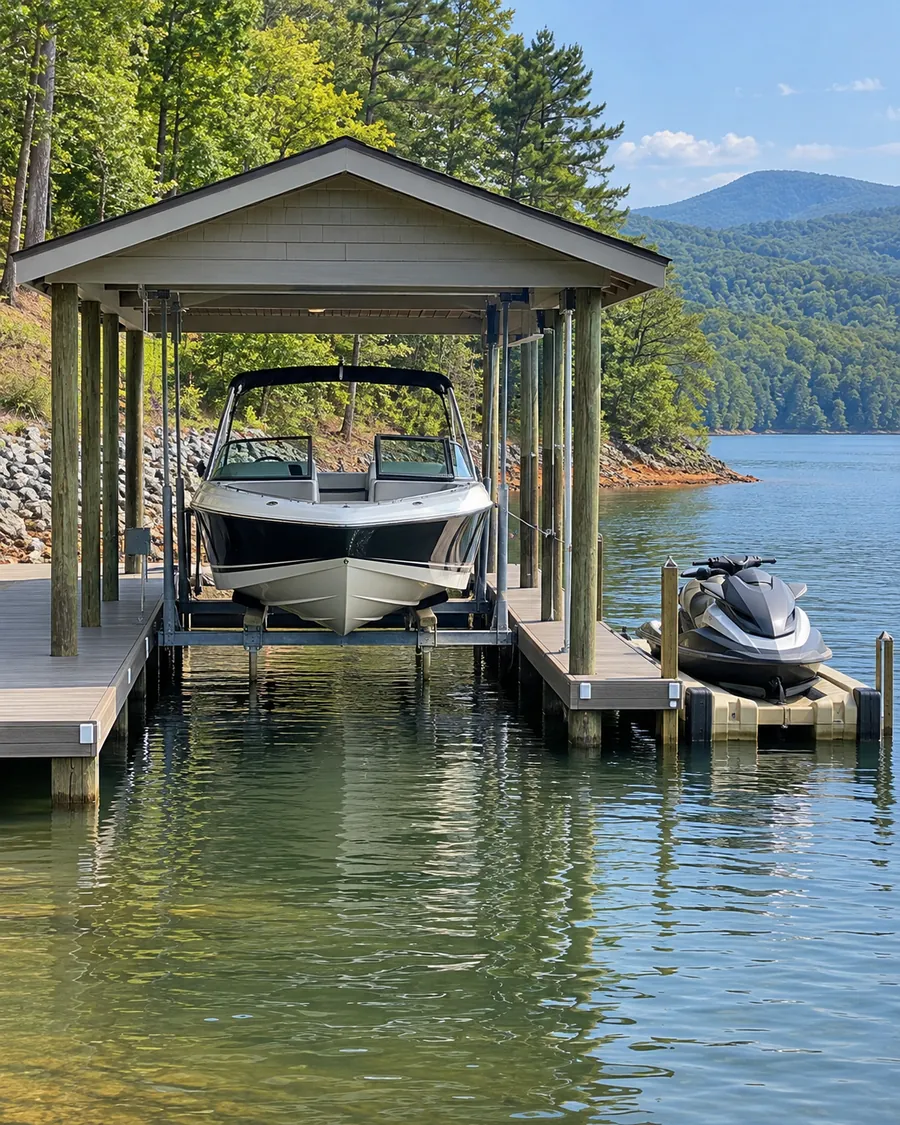
Adding a boat lift or a PWC lift to your Smith Mountain Lake dock, or fixing one that's quit, runs into a few AEP rules that surprise owners: how a lift counts against your slip limit, when AEP has to approve it, and how much water has to be under it. This page covers those rules, mooring whips and boat covers, the electrical issue lifts raise, and what repairing a lift costs compared with replacing it.
How AEP counts a lift
Every single-family dock has a slip limit tied to its shoreline: 2 slips for 100 to 300 feet, 3 for 301 to 600, 4 for 601 to 900. Whether a lift uses up one of those slips depends on how it's built:
- Bolt-on PWC lifts and floating ramps that can't be used or modified to hold a boat aren't counted as slips. Their area does count toward the dock's total square footage.
- Lift areas built into the dock, such as a single or double PWC slip, count as boat slips.
A worked example. With 200 feet of shoreline, the cap is 1,500 square feet and 2 slips. Say the dock already has two boat slips and covers 1,380 square feet. A bolt-on PWC lift with a footprint of about 100 square feet (a figure picked for the example) would bring it to 1,480 and stay legal without using a slip. Building a PWC slip into the dock instead would make a third slip, which the cap doesn't allow. The square-footage cap includes roof overhangs, so measure from the drip line, not the deck edge.
When AEP has to approve the work
AEP's FAQ says any new structure or modification that expands a structure needs its approval, and it applies that directly to lifts: any new or expanded PWC lift needs AEP's OK. On a new dock, lifts are part of the design AEP reviews: built-in lift areas count as slips on the surveyor's drawing, and any slip longer than 26 feet needs an oversized boat slip acknowledgement form.
The FAQ doesn't directly address swapping an old lift for a new one inside a slip that's already permitted. If the replacement is bigger, sits differently or changes the dock's footprint, treat it as an expansion. If it's truly the same size in the same spot, ask Shoreline Management (540-985-2579, shorelinemanagement@aep.com) before ordering it.
Mooring whips and boat covers
Mooring whips can be added to an existing dock without AEP approval. A retractable boat cover needs a permit only if it extends beyond the dock structure, roof overhangs included. A cover that stays inside that outline needs nothing from AEP.
Water depth at a PWC lift
In its rules for commercial, multi-use and public-use docks, AEP's plan requires at least 3 feet of water at a PWC lift on Smith Mountain Lake, measured at the 795-foot base elevation (Leesville Lake's minimum is 1 foot). Ask Shoreline Management what minimum it applies to a lift on a single-family dock. Because depth is measured at full pond, the real depth under a lift moves with the lake. AEP says normal operations can move the level up to 2 feet, and during the 2026 drought the lake sat about five feet below full pond for months (WSET, October 13, 2026). A lift in exactly 3 feet at full pond would have been sitting on dry bottom.
Digging out a shallow lift spot isn't simple either. Dredging needs both AEP and Corps permits, can remove only accumulated sediment, is barred from February 15 through June 15, and isn't allowed within 10 feet (measured horizontally) of the 795-foot contour or between the 793- and 795-foot contours. Ask whether the lift can sit farther out instead, within the dock's reach limit. Low water covers the drought's effect on docks and lifts.
Lifts, wiring and stray current
A powered lift puts a motor and its wiring over the water. Lifts come up directly in the SML Insiders' Guide's look at dock safety (updated January 1, 2026). After a drowning caused by stray current in the water, one contractor in the article argued for monitoring around the clock instead of a one-time test, since lowering a lift cradle on the next dock over can change what a meter reads. The same article names remote-controlled lifts as one of the upgrades pushing new-dock prices up.
Hooking up the motor is a job for an electrical contractor. The marine facility (MCC) specialty excludes electrical, HVAC and plumbing work by its own terms (18VAC50-22-30), and § 54.1-1100 says the Board requires a master tradesman license for electrical contractors. Ask who will wire the lift, and check that license on DPOR as well.
Repair or replace: what lifts cost
| Item | National figure | Source |
|---|---|---|
| Boat-lift repair | $175 to $500, about $340 average | HomeAdvisor, 2025 |
| Lift cable | $25 to $50 per linear foot | HomeAdvisor, 2025 |
| New boat lift | $2,000 to $20,000, about $8,000 average | Fixr, January 31, 2025 |
| Lift added to a new dock | $1,000 to $15,000 | HomeAdvisor, 2025 |
A worked example: if a lift needs 60 feet of new cable (a length picked for the example; ask what yours uses), that's 60 × $25 = $1,500 to 60 × $50 = $3,000. Against Fixr's $8,000 average for a new lift, the numbers favor re-cabling a lift whose frame, motor and cradle are sound. When the frame is corroded or bent, the motor is failing and the cables are shot all at once, the repair bill starts to approach a replacement, and a new lift may also fit the boat you have now. These are national figures, not quotes from the lake.
When a contractor looks at a tired lift, ask them to check the cables and their fittings, the pulleys, the motor and its switch, the cradle and bunks, the frame and its anchoring, and the wiring. A written list of what's worn makes it easier to compare a repair quote with a replacement quote.
Questions to ask about a lift job
- Is this a repair, a same-size replacement, or a new or bigger lift that needs AEP approval?
- Will the lift count as a slip, and does the dock have the square footage to spare?
- For a PWC lift, how deep is the water at the base elevation, and what minimum does AEP apply to this dock?
- Who does the electrical work, and what license do they hold?
- Does the price include taking out and disposing of the old lift?
- What warranty comes with the motor, cables and frame, and whose warranty is it?
Lift questions
Does a contractor need AEP approval to add a PWC lift?
Yes. AEP's FAQ says any new or expanded PWC lift needs its approval.
Does a bolt-on PWC lift count as a boat slip?
Not if it can't be used or modified to hold a boat. Its area still counts toward the dock's square-footage cap. A PWC slip built into the dock does count as a slip.
How deep does the water have to be at a PWC lift?
AEP's plan sets 3 feet on Smith Mountain Lake, measured at the 795-foot base elevation, for PWC lifts at commercial, multi-use and public-use docks. Ask Shoreline Management what applies to a single-family dock. When the lake is down, the actual depth is less.
Can a contractor install a boat cover without a permit?
Yes, if the cover stays within the dock structure and its roof overhangs. One that extends beyond them needs an AEP permit.
Is an old lift worth repairing?
It can be, if the frame is sound. National repair figures run a few hundred dollars and cable $25 to $50 a foot, against about $8,000 for an average new lift. Get both a repair and a replacement price when the wear is widespread.
How this site helps
Call (540) 410-1330 or send a request, and we'll connect you with one independent local contractor who works on docks and lifts around the lake. Contractors are responsible for their own licensing, insurance, permits, pricing and warranties.
Related pages
Sources
- AEP Shoreline Management FAQs
- AEP Shoreline Management Plan (FERC-approved February 18, 2025)
- AEP Occupancy and Use Permit application (updated 7/31/2026)
- 18VAC50-22-30 and Va. Code § 54.1-1100
- SML Insiders' Guide: dock trends (updated January 1, 2026)
- HomeAdvisor: dock repair cost (2025)
- HomeAdvisor: dock building cost (2025)
- Fixr: dock cost guide (January 31, 2025)
Lift stuck, slow or missing?
Tell us what you have and what it's doing, and we'll pass it to one independent local contractor who works on the lake.