Who Does Shoreline & Dock Work on Smith Mountain Lake? How to Hire
Shoreline and dock work on Smith Mountain Lake involves several trades, and one project can need three of them plus a surveyor. Before you hire anyone for riprap, a dock or a lift, it helps to know who does which part, which Virginia license classes and specialties apply (quoted from the regulation below), how to look a license up, what to ask about insurance and permits, what the written contract has to say, and why the AEP application is yours to sign.
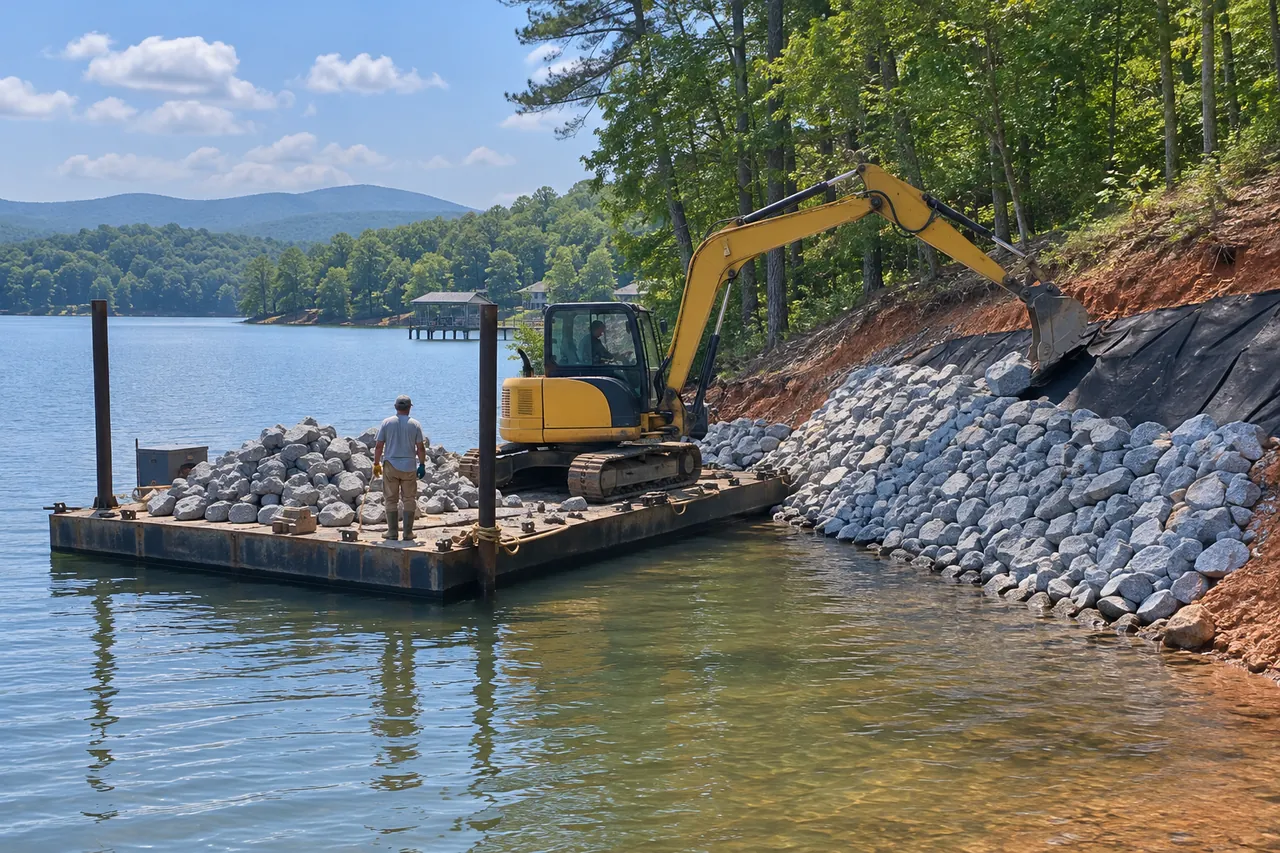
Which trades do what on the lake
- Dock and marine contractors build and repair docks and boathouses and install lifts. Some also place stone along the shore.
- Excavation, grading and landscape contractors handle riprap set from the land side, bank shaping, and the erosion controls the county permit requires. AEP's riprap form asks whether stone goes in from land or from the water, and that answer changes the equipment, the access and the price.
- Electricians wire dock lights, outlets and lift motors, handle grounding, and install stray-voltage monitors.
- Surveyors prepare the drawing for a dock permit, which AEP's form says must come from a licensed surveyor.
On a combined job, such as a new dock with stairs and stone at the landing, ask who's in charge of the whole thing and who's a subcontractor.
Virginia license classes: sized by the job
Va. Code § 54.1-1100 sorts contractor licenses into three classes by the dollar value of the work:
- Class C: a single contract or project "over $1,000 but less than $30,000," and less than $250,000 of work in any 12 months.
- Class B: a single contract of $30,000 or more but less than $150,000, or $250,000 to under $1 million in 12 months.
- Class A: a single contract of $150,000 or more, or $1 million or more in 12 months.
Put lake numbers against those lines. Two hundred feet of riprap at Angi's 2025 national range of $70 to $400 a foot is $14,000 to $80,000, which runs from Class C into Class B. A 1,500-square-foot dock at the $100,000 to $150,000 or more that builders quoted in the SML Insiders' Guide is Class B, or Class A once the contract reaches $150,000. HomeAdvisor's 2025 average dock repair of $3,201 is Class C. The same statute says the Board requires a master tradesman license for electrical, plumbing and HVAC contractors.
The specialties that fit lake work, in the regulation's words
A license also spells out what kinds of work it allows. Two definitions in the Board for Contractors' specialty list (18VAC50-22-30) matter most here. Word for word:
- LSC: "'Landscape service contracting' (Abbr: LSC) means the service that provides for the alteration or improvement of a land area not related to any other classification or service activity by means of excavation, clearing, grading, construction of retaining walls for landscaping purposes, or placement of landscaping timbers. This specialty may remove stumps and roots below grade. The CBC, RBC, and H/H classifications and the CIC and HIC specialties also provide for this function."
- MCC: "'Marine facility contracting' (Abbr: MCC) means the service that provides for the construction, repair, improvement, or removal of any structure the purpose of which is to provide access to, impede, or alter a body of surface water. The CBC and H/H classifications also provide for this function. The MCC specialty does not provide for the construction of accessory structures or electrical, HVAC, or plumbing functions."
The abbreviations are the commercial building (CBC), residential building (RBC) and highway/heavy (H/H) classifications, and the commercial improvement (CIC) and home improvement (HIC) specialties. None of the specialty definitions uses the words dock, riprap or boat lift. So rather than guessing which one fits your job, ask the contractor which classification or specialty they hold and why it covers the work, then check it yourself. Wiring falls outside MCC entirely.
How to look up a license on DPOR
- Ask for the license number. Virginia's rules for license holders put it on the residential contract, next to the class and the categories of work it covers.
- Enter it, or the company name, at DPOR License Lookup.
- Confirm the license is active, the class covers your contract amount, and the classification or specialty fits the work.
- Look at the disciplinary history. DPOR's consumer guide points owners to License Lookup for both license status and past disciplinary actions.
- Make sure the business name on the license matches the one on the contract, and look up the electrician separately if there's wiring.
Insurance questions to ask
- Will your insurance company issue a liability certificate for this job, and what limit does the policy carry?
- If the work is done from the water, does the policy cover equipment and work on the lake as well as on land?
- What happens if equipment damages a neighbor's dock, the shoreline next door, or my yard on the way in?
- Do you carry workers' compensation? Under the Virginia Workers' Compensation Commission's rules, coverage is required at three or more regular employees in the state, and a contractor has to count the people its subcontractors bring. The Commission's site links to an insurance coverage search.
Permit questions to ask
- Who prepares the Corps request in the Regulatory Request System, and who draws the site plan and cross-section for AEP's shoreline form?
- Who orders the surveyor's drawing for a dock permit?
- Who applies for the county erosion or building permit, and who sends the county's approval back to AEP?
- Is my shoreline in a Conservation/Environmental or Impact Minimization Zone area, where in-water work stops February 15 through June 15? If not, who files the bass-nest information for work between April 15 and June 15?
- How will trees removed for the stone be bundled and sunk, and how will bare soil be stabilized within seven days?
- If the dock or wall is old, has anyone asked AEP what can be repaired or replaced?
The permits guide explains each step.
The owner signs the AEP application
AEP's Shoreline Stabilization Permit application must be signed by all owners of record, and the form says an agent or contractor can't sign it, though your contractor can be listed. The dock application says the same of the deeded owners, and their signatures on the permit document must be notarized. A contractor can prepare most of the package, but read it before you sign, because the permit is issued in your name.
What the written contract should cover
For residential work, Virginia's contractor regulations (18VAC50-22-260) require a written contract, signed by both sides before work starts or payment is taken, that includes:
- When work begins and the estimated completion date.
- The total cost, or for cost-plus or time-and-materials work, how the price is figured.
- The progress-payment amounts and schedule, with the down payment stated.
- The materials and work you specifically asked for.
- A plain-language clause on delays beyond the contractor's control.
- A statement that the contractor will comply with local building permit, inspection and zoning requirements.
- Each side's cancellation rights.
- Your signed acknowledgment that you received DPOR's statement of consumer protections.
- Who the contractor is: name, address, license number and class, and the specialties or classifications held.
- A statement that changes to cost, materials, work or dates must be in writing and signed by all parties.
- Notice of the Virginia Contractor Transaction Recovery Fund.
For lake work, add the specifics: who obtains each AEP, Corps and county permit; dimensions that match the permit; for riprap, the stone class, length along the 795-foot line, slope and toe depth; the erosion controls; where cut trees go; reflectors on dock edges; cleanup; and the contractor's warranty terms, in writing.
For the down payment, DPOR's consumer guide says to keep it to the smaller of 10 percent or $1,000 (up to 30 percent when materials are custom-made or special-ordered), to tie each later payment to finished work, and to hold the final payment until the job is complete. On a $40,000 riprap job, 10 percent would be $4,000, so the guide's cap is $1,000. Its warning signs include door-to-door selling, being rushed into a decision, a demand for the whole price up front, and payment only in cash or through Venmo-type apps.
Hiring questions
Can a contractor sign the AEP permit application for the owner?
No. Every owner of record signs the shoreline form, and the deeded owners sign the dock form and the notarized permit. The contractor can be named on the shoreline form.
Does a contractor need a Virginia license for a small dock repair?
Class C starts at a contract of over $1,000, so most dock repairs are in license territory. Ask for the number and check it.
Can a landscape contractor install riprap?
The regulation doesn't name riprap. LSC covers altering land by excavation, clearing and grading; MCC covers structures that "impede, or alter a body of surface water." Ask the contractor which license they're relying on and why, then look it up.
Who should wire a dock or a lift?
An electrical contractor. The MCC specialty excludes electrical work, and the statute requires a master tradesman license for electrical contractors. See dock repair for the stray-current concern on the lake.
Should the contractor or the owner get the county permit?
Either can be arranged, but the contract should say who. Virginia's contract rules require a statement that the contractor will comply with local permit, inspection and zoning requirements.
How this site helps
Call (540) 410-1330 or send a request, and we'll connect you with one independent local contractor who works on the lake. Contractors are responsible for their own licensing, insurance, permits, pricing and warranties, so check the license on DPOR and work through the questions on this page before signing anything.
Related pages
Sources
- Va. Code § 54.1-1100
- 18VAC50-22-30
- 18VAC50-22-260
- DPOR License Lookup and DPOR consumer guide to hiring a contractor
- Virginia Workers' Compensation Commission: employers
- AEP Shoreline Stabilization Permit application (updated 5/21/2026)
- AEP Occupancy and Use Permit application (updated 7/31/2026)
- Angi: riprap cost (2025 data), HomeAdvisor: dock repair cost (2025), SML Insiders' Guide (updated January 1, 2026)
Ready to talk with someone who works on the lake?
Tell us what you need done and where, and we'll pass it to one independent local contractor.