Seawalls & Bulkheads on Smith Mountain Lake: What AEP Allows
If the bank in front of your Smith Mountain Lake house is caving in, a concrete or timber seawall may be the first fix you picture. On this lake it's usually off the table: AEP prohibits bulkheads unless FERC grants a variance. This page explains that rule, why AEP steers owners toward plantings and sloped stone instead, what the realistic alternatives cost, and what to do if your lot already has an old wall that's failing.
The rule: no new bulkheads without a FERC variance
AEP's Shoreline Management FAQ puts it in one line: "Bulkheads are prohibited unless a FERC variance is obtained." The variance falls under section 3.4.1 of the Shoreline Management Plan, and AEP says it is approved only in limited situations where other stabilization methods won't work. The decision belongs to the Federal Energy Regulatory Commission, which licenses the Smith Mountain Project, not to AEP alone. Ask AEP Shoreline Management (540-985-2579) how a variance request works before planning around one.
The FAQ talks about bulkheads and doesn't list seawalls separately. Lake owners tend to use both words for a vertical wall of timber, concrete, steel or block that holds soil back at the water's edge, so assume AEP will treat a seawall the same way unless Shoreline Management tells you otherwise.
The counties have a say as well. Va. Code § 15.2-1226 names bulkheads among the structures Bedford, Franklin and Pittsylvania may regulate below the 800-foot contour, covering their location, size and length, for safe navigation.
Why AEP points owners toward plants and stone
AEP sets a clear order for fixing an eroding bank: vegetation first, then bioengineering, which pairs plants with structure, and then hard armoring such as riprap, which is allowed only where erosion is active. The plan's figures on bioengineering show live staking, live fascines and joint planting: live cuttings driven into the bank, bundles of live branches laid along the slope, and cuttings set between stones.
AEP's rules also show what it's protecting. Trees cut for a shoreline project get bundled and sunk as fish cover, work between April 15 and June 15 needs details about largemouth bass nests, nothing may be placed in wetlands, and every job has to keep sediment out of the water.
Shoreline scientists make a similar case. The Shoreline Studies Program at the Virginia Institute of Marine Science, writing about Chesapeake Bay shorelines, says bulkheads "create a hard barrier between the upland and the water," usually leaving no vegetated zone in front. It says sloped, rough revetments "decrease wave reflection and, therefore, bottom scour," and that wooden bulkheads "will deteriorate over time and eventually fail," with failed walls tending to be reinforced or replaced with revetments. Smith Mountain Lake isn't tidal, so read that as general context rather than a study of this lake.
The realistic options
Plantings
AEP's first choice. Roots hold soil and slow runoff, which suits a gentle slope with surface wash rather than a bank that's collapsing. Remember the vegetation rules inside the Project boundary: anything beyond pruning, limited thinning and stems under ½ inch means asking AEP about a Vegetation Removal Permit, so check before clearing to replant.
Bioengineering
Plants with structure: live stakes in the bank, branch bundles in shallow trenches, or cuttings tucked between stones. It suits banks that need more than grass but aren't failing outright.
Riprap
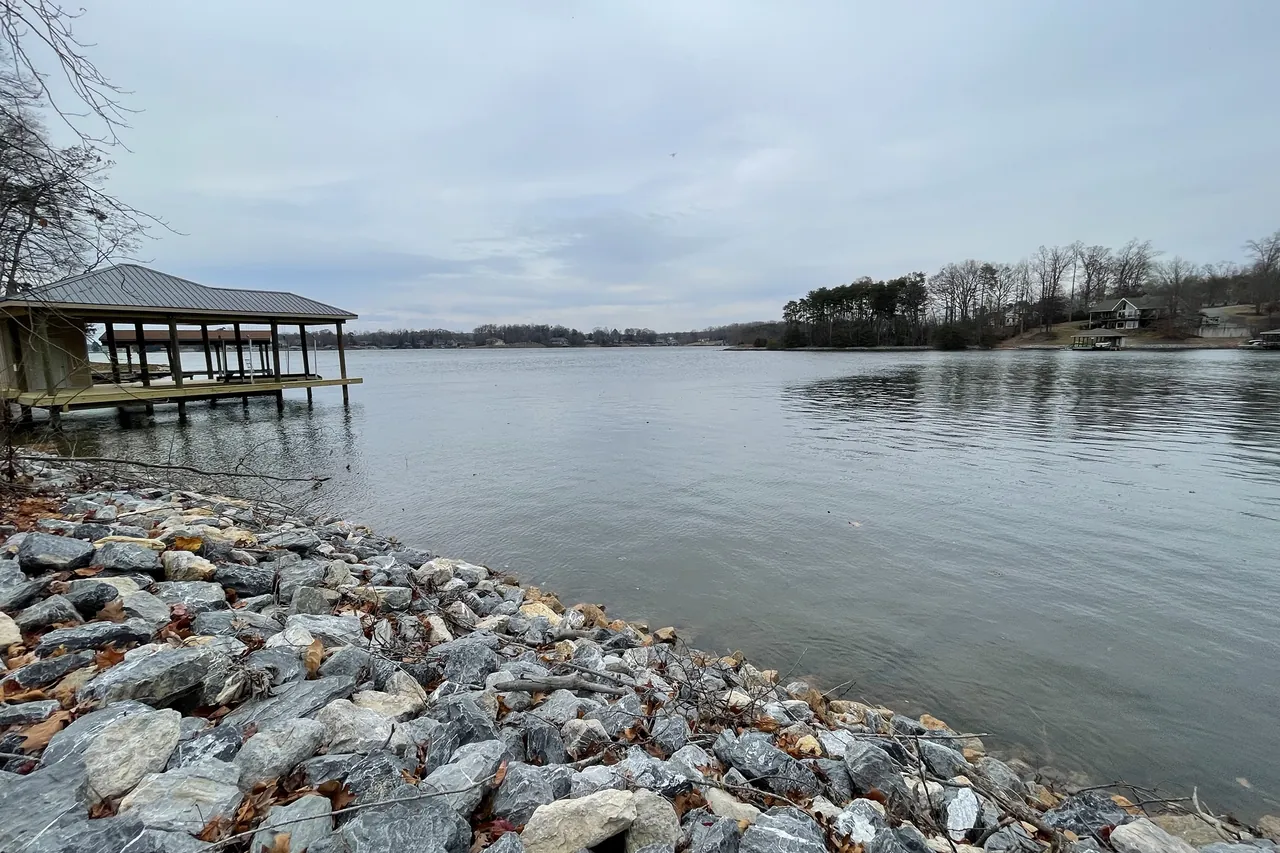
The hard option AEP permits where erosion is active. It needs a Corps permit, then AEP's Shoreline Stabilization Permit, then a county erosion permit, and it has to meet AEP's specs: clean rock no smaller than VDOT Class I, a toe buried at least 12 inches, and a final slope no steeper than 2:1. That slope is the trade-off owners notice. A 2:1 face runs 2 feet out for every foot of height, so a 4-foot bank needs about 8 feet of stone measured level, where a wall would stand straight up. The riprap guide covers the details.
If your lot already has a seawall that's failing
AEP's FAQ, its plan and its permit forms don't spell out what repairs are allowed on an existing bulkhead. That gap is the reason to go to AEP before anyone else touches the wall.
- Contact AEP Shoreline Management first (540-985-2579, shorelinemanagement@aep.com). Ask whether a permit for the wall is on record and what repair, removal or replacement AEP would allow.
- Gather what you have: your deed, any AEP permits for the lot, the year the wall went in if you know it, and photos of the problem, such as leaning sections, gaps with soil washing through, holes opening behind the wall, or a scoured base.
- Don't assume like-for-like is allowed. The terms printed on AEP's Occupancy and Use Permit application say nonconforming structures other than docks or piers inside the Project boundary "shall not be replaced." Whether AEP applies that to an older wall is AEP's call, but it's reason enough to ask before ordering materials.
- Ask what AEP would accept instead, for example sloping the bank and armoring it with riprap, or placing stone in front of the wall. Any new riprap goes through the Corps, AEP and county steps.
- Keep people off a wall that's moving and away from the ground right behind it until it's dealt with.
If the wall sits next to Resource Protection Area shoreline, AEP's plan also requires structures, shoreline stabilization included, to stay 30 feet from the edge of the RPA classification.
What the alternatives cost
There's no price here for a new bulkhead, since one can't be built without a FERC variance. Riprap is the usual hard alternative. Angi's 2025 national data puts riprap at $70 to $400 per linear foot including materials and labor, with an average project of about $20,000, most jobs between $10,000 and $30,000, and the high end for steep slopes, trees and rough-water sites.
For 120 feet of frontage, that works out to 120 × $70 = $8,400 at the low end and 120 × $400 = $48,000 at the high end. Taking out an old wall, if AEP wants it gone, is extra and isn't in those numbers. AEP charges nothing for its permits; the county's permit fees are separate. These are national figures, not quotes from the lake, and the cost guide has more.
A retaining wall up the yard is a different question
AEP's Project boundary ends at the 800-foot contour. A landscape wall built entirely above that line, say to terrace a slope by the house, sits outside the boundary AEP manages, but county rules still apply: Bedford requires a Land Disturbing Permit for any disturbance within 200 feet of a body of water, and Franklin requires a permit at 3,000 square feet or more within 200 feet of surface water. If the wall would come close to 800 feet, ask AEP where the line falls before digging.
Virginia's contractor regulations separate the two jobs. The Landscape Service Contracting specialty covers "construction of retaining walls for landscaping purposes," while Marine Facility Contracting covers structures meant "to provide access to, impede, or alter a body of surface water" (18VAC50-22-30). Who does the work explains how to check a contractor's license.
Seawall questions
Can a contractor build a new seawall on Smith Mountain Lake?
Only if FERC grants a variance under section 3.4.1 of AEP's plan, which AEP says happens only where other methods won't work. For most eroding banks, the permitted routes are plantings, bioengineering or riprap.
Can a contractor repair an existing seawall without a permit?
AEP's published rules don't answer that. Call Shoreline Management with photos before any repair, and get its answer in writing if you can.
Can riprap go in front of an old wall?
Ask AEP. Adding riprap anywhere needs the Corps permit and AEP's Shoreline Stabilization Permit, and the stone has to meet AEP's size, slope and toe specs.
Does a wall above the 800-foot line need AEP's sign-off?
A wall entirely above 800 feet is outside AEP's Project boundary, but the county's land-disturbance and building rules still apply, and near the water those kick in at small sizes.
How this site helps
Call (540) 410-1330 or send a request, and we'll connect you with one independent local contractor who works on lake shorelines. Contractors are responsible for their own licensing, insurance, permits, pricing and warranties.
Related pages
Sources
- AEP Shoreline Management FAQs
- AEP Shoreline Management Plan (FERC-approved February 18, 2025)
- AEP Shoreline Stabilization Permit application (updated 5/21/2026)
- AEP Occupancy and Use Permit application (updated 7/31/2026)
- VIMS Shoreline Studies Program: defensive structures
- Va. Code § 15.2-1226
- 18VAC50-22-30
- Angi: riprap cost (2025 data)
Losing ground at the waterline?
Tell us about the bank or the old wall, and we'll pass it to one independent local contractor who works on the lake.