Low Water on Smith Mountain Lake: Banks, Docks & Lifts After the 2026 Drought
If your lift sat high and dry this year, or you could see rocks under your Smith Mountain Lake dock that usually stay submerged, this page is for you. It covers what happened to the lake level in 2026, what Appalachian Power's rules already say about low water, what you can and can't do on shoreline that's out of the water, and what to have checked on banks, docks and lifts as the lake comes back up.
What happened to the lake in 2026
Full pond on Smith Mountain Lake is 795 feet. Here's how the year went, as reported by local news:
- January 12. WSLS reported the lake at some of its lowest levels in nearly a decade amid severe drought, with rocks that are normally under water showing beneath docks. A charter operator said, "I have no water under my lift." An Appalachian Power spokesperson said the company has to release a set amount of water downstream.
- April 27 and May 11. Appalachian Power began reducing outflows from the dams under its approved drought plan, moving to stage one on April 27 and stage two on May 11 (WSLS, May 19).
- June 16. AEP told the Franklin County Board of Supervisors the lake remained around 790 feet, about five feet below normal, and that its plan is based on water availability and inflow, "not a fixed lake elevation" (WSLS, June 24).
- July 13. The lake was still more than five feet below full pond, and Smith Mountain Lake Fire and Rescue described land out of the water that boaters hadn't seen before (WDBJ7).
- September 17. Levels had dropped nearly 6 feet below full pond during summer heat, and AEP said it was running its turbines more often to meet power demand (WSET).
- October 13. After weekend rain, the lake was at about 790¾ feet and nearing 791, according to the Smith Mountain Lake Association's Water Safety Council, after sitting about five feet below full pond for months. It still had a few feet to go (WSET).
AEP's Smith Mountain Project site, SmithMountainProject.com, posts current lake levels and drought information.
What AEP's rules already say about low water
AEP's Shoreline Management Plan sets the normal maximum operating level at 795.0 feet, says the lake can move up to 2 feet during a normal generation and pumpback cycle, and says it can run lower during low inflow. A dock permit doesn't promise water, either. Under the plan, dock owners sign an acknowledgement that water depths "may not be adequate for accessing the lake during times of low inflow or drought," or whenever the reservoir is drawn down for another reason.
That puts limits on chasing deeper water. A single-family dock can reach no more than one-third of the cove's width or 100 feet from the base elevation, whichever is less, has to leave a 30-foot passage lane and stay 15 feet off the dock delineation line, and any change that makes a dock bigger needs AEP approval. Any new or expanded PWC lift needs AEP approval too.
Dredging: the rules if you want depth back
Dredging around a dock may be allowed with permits from both AEP and the Army Corps, under conditions listed in AEP's shoreline FAQ:
- Only accumulated sediment can be removed.
- No dredging in wetlands.
- No dredging during fish spawning season, February 15 to June 15.
- No dredging within 10 feet, measured horizontally, of the 795-foot contour, and none between the 793- and 795-foot contours.
- Dredging also has to meet all county, state, federal and AEP dredging requirements (Section 2.5.4 of AEP's plan).
The strip between 793 and 795 feet is the ground right below full pond, and with the lake near 790 this year, that band was out of the water. It stays off-limits to dredging no matter how dry it looks.
Your bank while the water is down
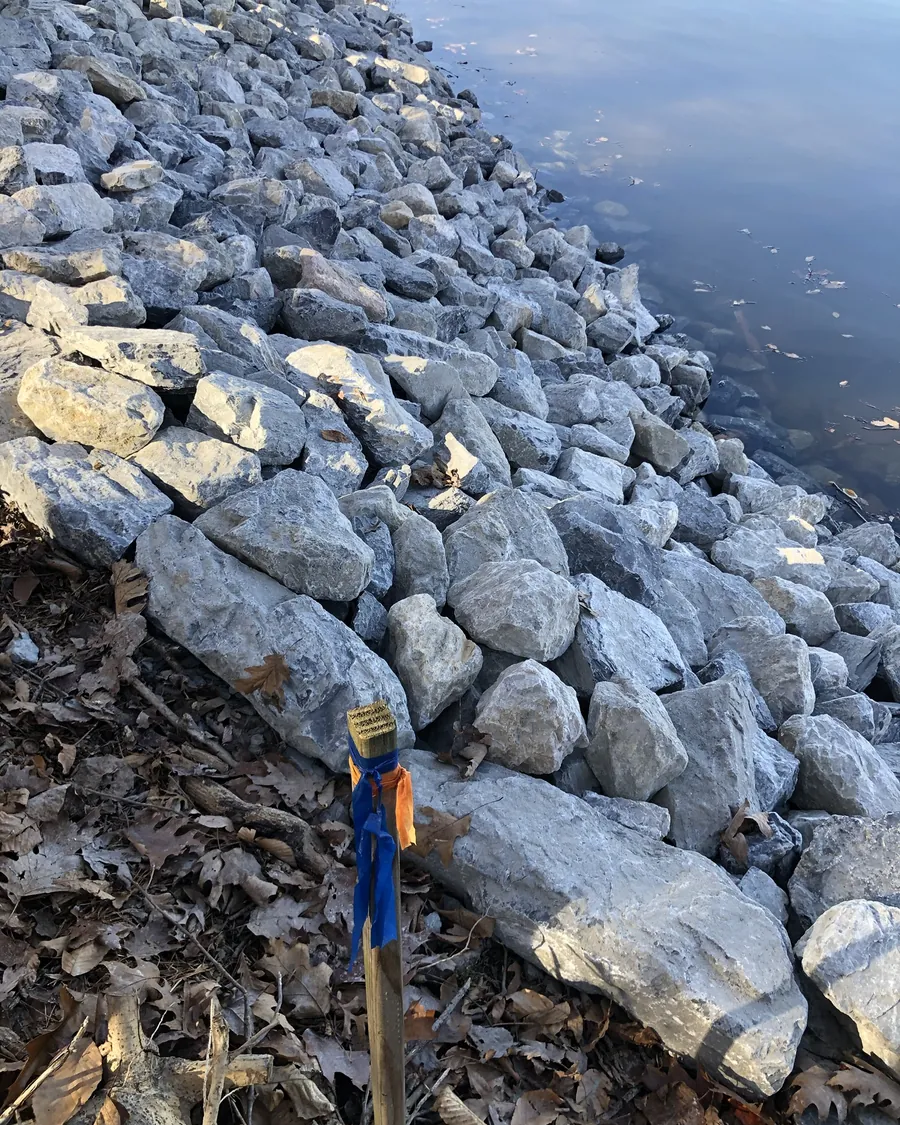
The ground uncovered by a low lake sits below 795 feet, inside the Project boundary that runs up to the 800-foot contour, so AEP's permits still apply to it. What a low lake does give you is a look at the lower bank. Check whether the base is undercut, whether old riprap still reaches as far down as it did, and where soil is slumping, and take photos with the date and lake level. Shoreline erosion explains how AEP defines active erosion.
- Allowed without a permit: rearranging existing riprap within its original length, width and height.
- Needs AEP and Corps permits: adding riprap, or new riprap anywhere.
- Not allowed: sand below 795 feet, new beaches, or material placed in wetlands.
- Discouraged: removing woody debris unless it's a hazard.
A Sea Tow captain told WSET in October that debris on the shore comes off into the lake as the water rises. Move your own loose lumber, floats and gear above the full-pond line before the lake gets back to it.
AEP's riprap application asks whether the stone goes in from land or from the water, and the permits still come in the same order: Corps, then AEP, then the county. Whether a lower lake makes a particular job simpler is a question for the contractor who looks at it, and the February 15 to June 15 limits apply regardless of the level. The riprap guide has the full requirements.
Docks and lifts after a dry year
If a floating section or a lift sat on the bottom this year, ask a contractor to look it over, pilings and lift cables included, before next season. Plenty of that work needs no AEP permit: replacing surface materials, siding or roof shingles, and painting or staining, as long as the dock's dimensions, configuration and location stay the same. A new structure, or anything that makes the dock bigger, needs AEP approval. Mooring whips can be added without approval, and a retractable boat cover needs a permit only if it extends beyond the dock.
For budgeting, HomeAdvisor's 2025 national figures put piling repair at $200 to $700 each and replacement at $300 to $1,600, boat lift repair at $175 to $500 (averaging $340), and lift cable at $25 to $50 per linear foot. Dock repair and boat lifts go further.
One more thing as the water returns: the SML Insiders' Guide notes that the three counties adopted wiring and grounding standards for new dock construction, mentions a drowning caused by stray current, and says stray-voltage monitoring is available. If any dock wiring was moved, stretched or damaged while the water was down, have it checked before anyone swims near the dock.
On the water while it's low
Smith Mountain Lake Fire and Rescue's advice in July was to slow down, watch for shallow spots and newly exposed islands, and take extra care after dark. AEP asked people in May to "use extra caution on and around the water," and in September Virginia Conservation Police urged boaters to stay aware of changing conditions while officials reminded them to wear a life jacket.
Low water questions
Can a contractor extend my dock into deeper water?
Only with AEP approval and within AEP's limits: one-third of the cove width or 100 feet from the base elevation, whichever is less, plus the dock's size cap for your frontage. New docks and boathouses lists those limits.
Can a contractor dredge around my dock while the lake is down?
Only with AEP and Army Corps permits, only accumulated sediment, never in wetlands, never from February 15 to June 15, and never between the 793- and 795-foot contours or within 10 feet of the 795-foot contour.
Can old riprap be reset while it's exposed?
Yes, as routine maintenance, as long as the stone stays within its original length, width and height. Bringing in more stone needs the AEP and Corps permits.
Does work on the exposed lake bottom need a permit?
Generally, yes. That ground is inside the Project boundary, so stabilization, dredging and new structures there all need AEP approval. If you're unsure whether something counts as maintenance, AEP's FAQ says to contact Shoreline Management at 540-985-2579 before starting.
Where can I check the lake level?
SmithMountainProject.com, AEP's site for the Smith Mountain Project, posts current lake levels and drought information.
How this site helps
Call (540) 410-1330 or send a request about the bank, dock or lift, and we'll connect you with one independent local contractor who works on the lake. They take a look and quote the work in writing. The referral costs you nothing, and the contractor is responsible for their own licensing, insurance, permits, pricing and warranties.
Related pages
Sources
- AEP Shoreline Management Plan (2025): Secs. 1.4, 2.5.1 and 2.5.4
- Appalachian Power shoreline FAQ
- WSLS, January 12, 2026
- WSLS, May 19, 2026
- WSLS, June 24, 2026
- WDBJ7, July 13, 2026
- WSET, September 17, 2026
- WSET, October 13, 2026
- HomeAdvisor, boat dock repair cost (2025)
- SML Insiders' Guide, dock trends (updated January 1, 2026)
Dry year leave you with a problem?
Bank, dock or lift, one independent local contractor can take a look. The referral is free.