Riprap on Smith Mountain Lake: Rules, Stone, Cost & Permits
If your bank on Smith Mountain Lake is caving in, undercut, or losing soil every time the wakes roll in, riprap is probably the first fix you've heard about. On this lake it isn't only your call: Appalachian Power's shoreline rules decide when stone is allowed and how it goes in. This page covers when AEP will consider riprap, the stone, slope and toe it requires, the Army Corps, AEP and county permits in order, the spring work limits, what to do with old riprap, what riprap costs per foot, and where jobs go wrong.
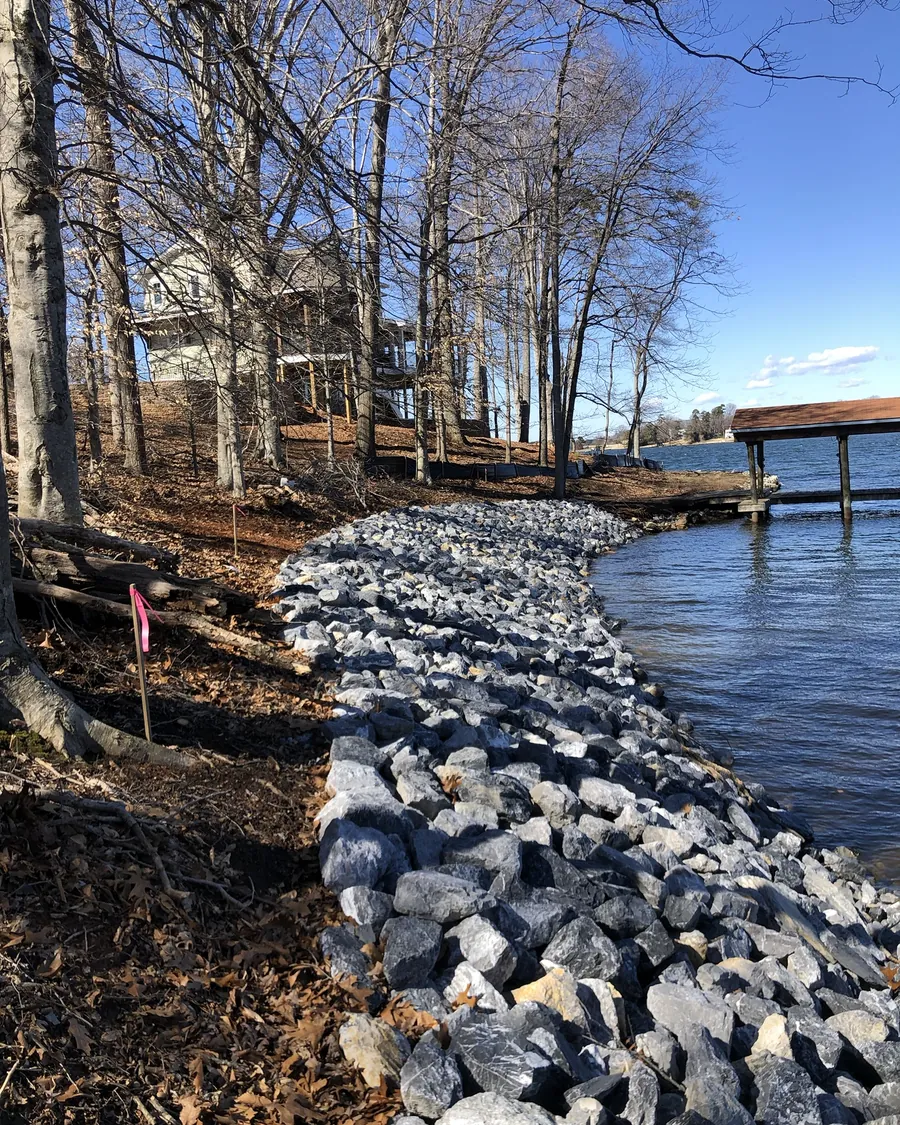
Who decides whether your bank gets stone
Smith Mountain Lake is a hydroelectric reservoir that Appalachian Power (AEP) operates under a license from the Federal Energy Regulatory Commission. The Project boundary follows the 800-foot contour, and the lake's base elevation, the normal full-pond line, is 795 feet. Shoreline length is measured along that 795-foot line. The strip between the two is Project land that AEP manages, even though it sits in front of your house.
That's why AEP's shoreline FAQ answers "May I stabilize my shoreline?" with yes, but a permit is required. For riprap specifically, the permit comes from AEP and the U.S. Army Corps of Engineers, and then the county issues its erosion-and-sediment permit. A contractor can be listed on the application, but every owner of record has to sign it.
When AEP will consider riprap
AEP ranks the options. Owners are encouraged to use vegetation to control erosion first, then bioengineering, which combines plants with structure, and hard armoring such as riprap last. Riprap is generally considered only where there's active erosion, which AEP's Shoreline Management Plan defines as one of three things:
- areas that are bare and void of vegetation or other stabilizing material,
- areas that are undercut or sloughing off the parent material, or
- areas right next to the shoreline that could deposit sediment or soil into the lake.
If your bank is grassy and holding, expect AEP to point you toward planting or bioengineering rather than stone. Shoreline erosion explains how to read your own bank against that definition and what the softer fixes look like.
The stone, slope and toe AEP requires
AEP's Shoreline Stabilization Permit application (updated May 21, 2026) and its FAQ set the build specs. Any quote you get should match them line for line.
AEP's riprap specs
- Stone
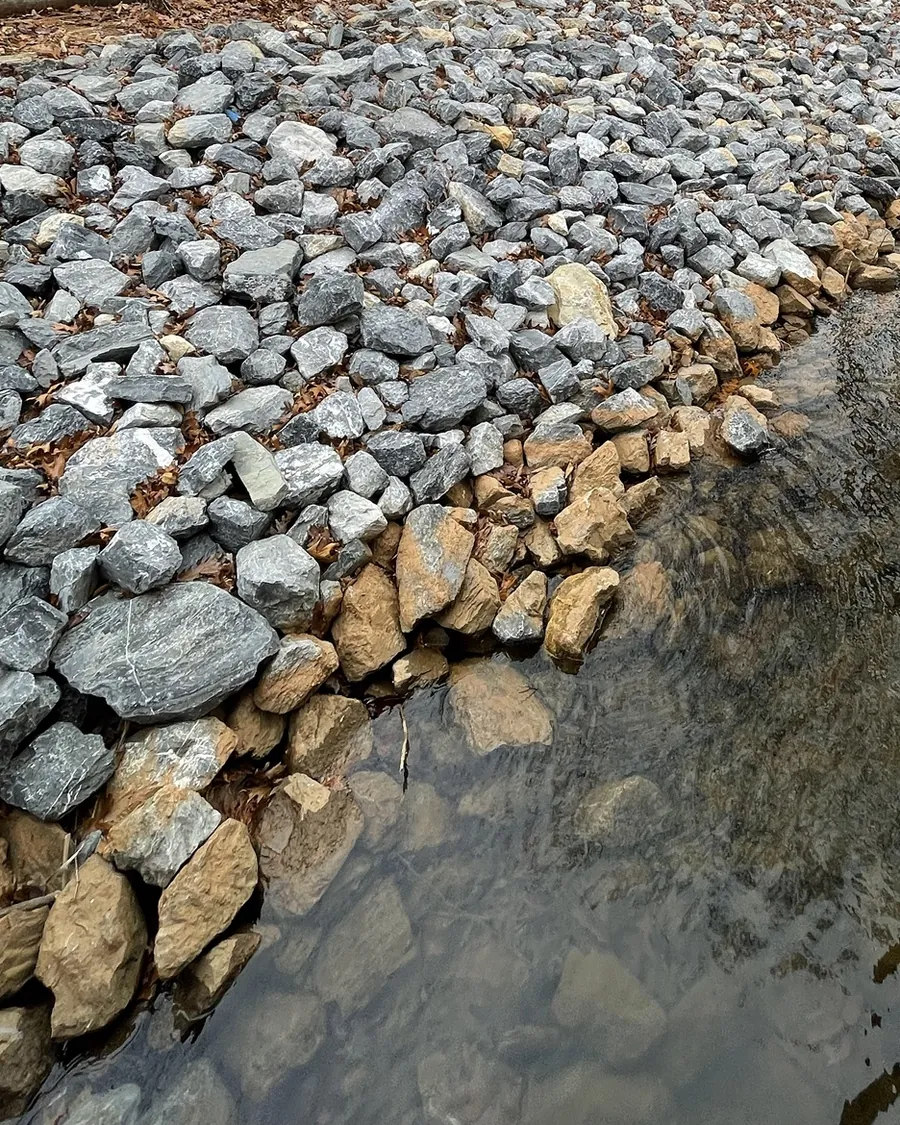
- Clean, solid rock, VDOT Class I at minimum
- Stone weight
- 50 to 150 pounds each, at least 60% over 100 pounds, and about 10% may be 50 pounds or less
- Slope
- No steeper than 2:1 when finished: two feet out for every foot up
- Toe
- Buried at least 12 inches
- Quantity
- No more material than erosion control needs
- Measurements
- Total length along the 795-foot base elevation, and how far the stone reaches from that line
- Filter fabric
- A yes-or-no question on the form; no requirement is stated
- Installed from
- Land or water; the form asks which
Virginia's Erosion and Sediment Control Handbook (Std. & Spec. 3.19, Riprap) adds useful background. It describes riprap as "a permanent, erosion-resistant ground cover of large, loose, angular stone with filter fabric or granular underlining," explains that the fabric sits between stone and soil to "prevent soil movement into or through the riprap," and notes that riprap on lakes and ponds may be subject to wave action. It also says fabric shouldn't be used on slopes steeper than 1½:1, which AEP's 2:1 limit already rules out. AEP's form leaves fabric as a choice, so ask the contractor whether they plan to use it and why.
What can't go into the bank
The same application lists what's prohibited. Watch for these in any plan or quote:
- Tires, scrap metal, crushed block, and other unsightly material.
- Any material placed in wetlands.
- Stone that blocks surface flows.
- Work that changes the Project boundary.
- Anything that unreasonably interferes with navigation or public use of the lake.
If your shoreline is next to a stretch AEP classifies as a Resource Protection Area, structures, including shoreline stabilization, have to stay 30 feet back from the edge of that classification.
Trees, roots and plants in the way
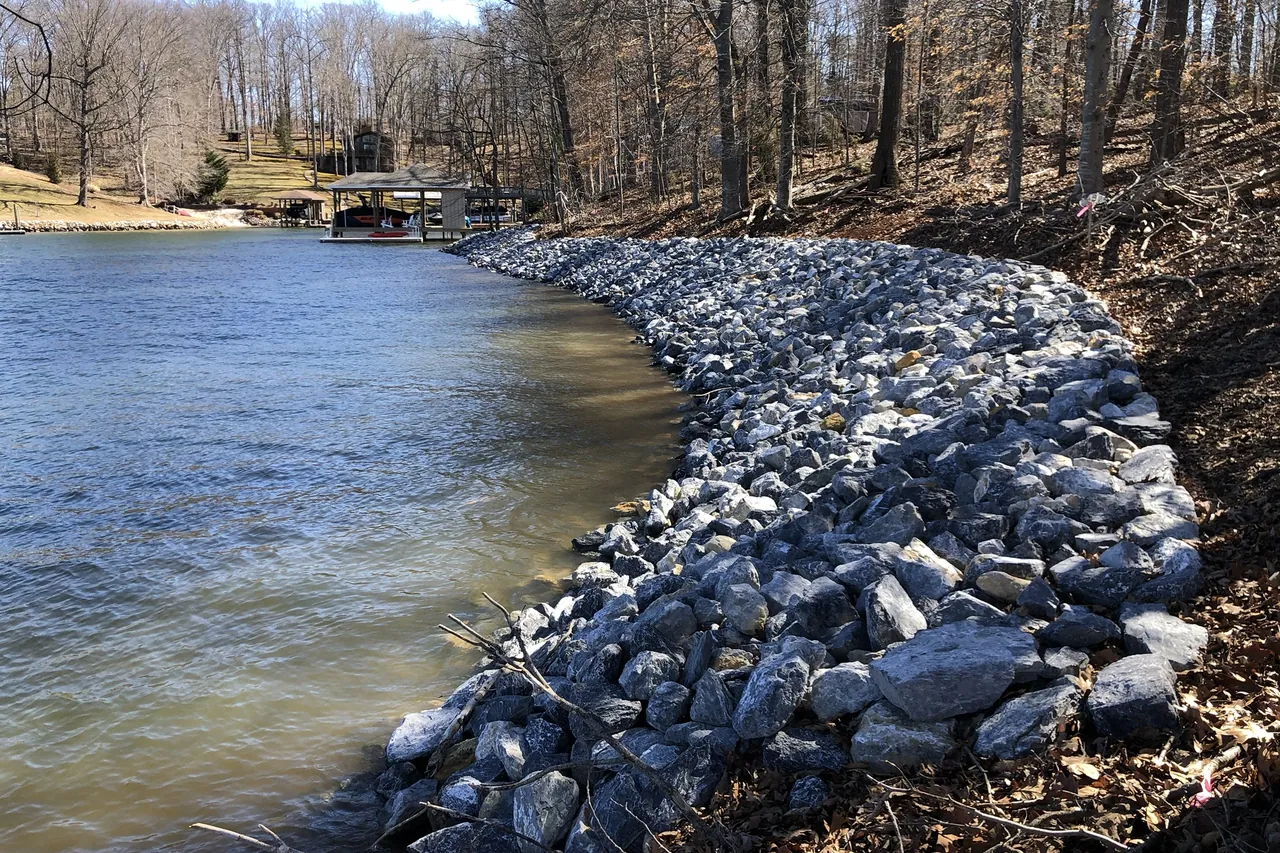
Clearing for stone is regulated too. Trees or woody material removed for riprap are collected, bundled, and sunk along the adjacent shoreline in water no deeper than 15 feet, which puts fish habitat back. If sinking doesn't fit your site, or the contractor needs extra clearing to get equipment to the bank, a separate Vegetation Removal Permit may be needed. Vegetation that comes out has to be replanted or mitigated under Table 2.5-2 of AEP's plan, or fish habitat structures installed instead.
Without any permit, AEP allows removing plants under half an inch in diameter, pruning (not topping), and thinning or limbing up to 20% of the canopy or 14 feet, whichever is less. Cutting more than that to make room for an excavator is a permit question, not a judgment call on the day.
The permits, in the order they happen
- Army Corps permit. Apply online through the Corps' Regulatory Request System. AEP's form says the Corps permit has to be issued before AEP authorizes the work.
- AEP Shoreline Stabilization Permit. Send the signed application and terms, a site plan showing the 800-foot Project boundary, the 795-foot base elevation, shoreline length, property lines and extended property lines, a plan view and cross-section with every dimension, and the Corps permit documentation. Every owner of record signs; a contractor or agent can be listed but can't sign for you. Incomplete applications come back. After AEP receives a complete one, it visits the site. AEP charges no permit fee. Questions go to Shoreline Management at 540-985-2579 or shorelinemanagement@aep.com.
- County erosion-and-sediment permit. Once AEP issues its permit, get the E&S permit from your county and forward the approved permit to AEP. Bedford County requires a Land Disturbing Permit for disturbance over 10,000 square feet or within 200 feet of a body of water regardless of size, so lakefront riprap in Bedford falls under it. Franklin County's local ordinance requires a permit for 3,000 square feet or more within 200 feet of surface water. Pittsylvania County requires a land disturbance permit to disturb more than 10,000 square feet, and its page lists no separate rule for land near the water.
- On the job. Erosion and sediment controls go in before clearing and grading, and all bare soil has to be stabilized within 7 days after final grade.
For a sense of scale under Franklin's rule: a hypothetical 200 feet of shoreline worked 15 feet back from the water is 3,000 square feet. The permits guide covers dock, stairs and dredging permits too.
Timing: the spring spawning window
A 2007 FERC order, cited in AEP's 2025 Shoreline Management Plan, prohibits in-water construction from February 15 to June 15 in Conservation/Environmental and Impact Minimization Zone areas. In-water work between April 15 and June 15 also needs extra information about largemouth bass nests: the order calls for a written report on the site, including the type of bottom material, the exact location on the lake, photographs, and any visible signs of nests. If a nest is found, the work may be modified or delayed.
Plan backward from those dates: the Corps permit, AEP's review and site visit, and the county permit all come before any stone moves. Ask AEP early which shoreline classification and zone your lot falls in.
Old riprap that has shifted or slumped
Routine maintenance of existing riprap needs no permit. AEP counts rearranging stone within its original length, width and height as maintenance, so pulling fallen rock back into place and resetting it, inside the original footprint, is allowed. Adding riprap is a different job: more stone, or stone that extends the old footprint, needs the AEP and Corps permits. If you're not sure which side of that line a repair falls on, AEP's FAQ says to contact them before starting.
What riprap costs
Angi's guide, using 2025 national data, puts riprap at $70 to $400 per linear foot for materials and labor, with an average project of $20,000 and most between $10,000 and $30,000. Most projects run 100 to 300 linear feet, and difficult access, such as steep slopes, trees and high-wave areas, pushes the price toward $400 a foot. Worked out at Angi's range:
- 100 feet at $70 to $400 a foot: $7,000 to $40,000
- 200 feet at $70 to $400 a foot: $14,000 to $80,000
- 300 feet at $70 to $400 a foot: $21,000 to $120,000
For a local reference point: we have a house on the lake in Huddleston, and in January 2021 we paid about $24,000 for about 200 ft of riprap on our own shoreline, about $120 a foot. AEP's permit is free, so Angi's national permit figure of $525 to $3,050 doesn't describe the AEP side here, though county fees still apply. The cost guide covers per-ton pricing, what moves the number, and dock and lift costs.
Where riprap jobs run into trouble
Each of these breaks a written rule, so check for them before work starts:
- Stone goes in before the Corps permit is issued and AEP has authorized the work.
- The contractor signed the application instead of every owner of record.
- The stone is smaller than Class I, or the load includes crushed block or broken concrete.
- The face is steeper than 2:1, or the toe sits on the surface instead of 12 inches down.
- More stone is placed, or placed farther out, than the permit drawings show.
- Cleared trees are hauled away instead of bundled and sunk, or more is cut than allowed.
- Bare soil sits for more than 7 days after final grade.
- In-water work is scheduled inside the spring window without the bass-nest information.
- The approved county permit never gets forwarded to AEP.
- Old riprap gets "topped off" with new stone and called maintenance.
When riprap isn't the right fix
- The bank isn't actively eroding. AEP's order puts planting and bioengineering first. See shoreline erosion.
- You want a vertical wall. Bulkheads are prohibited unless FERC grants a variance under Section 3.4.1 of AEP's plan. See seawalls and bulkheads.
- You want a beach. New beaches are prohibited outside Public Use areas with a FERC variance, and no sand can go below 795 feet.
- The real problem is water depth at the dock. Dredging is a separate AEP and Corps permit with its own limits. See low water.
- Water is pouring down from the yard. Stormwater structures can't discharge directly into the Project boundary and have to sit above 800 feet, so that fix starts uphill.
Licensing for riprap work
Under Va. Code § 54.1-1100, the license class follows the size of the contract: more than $1,000 but less than $30,000 is Class C, $30,000 up to $150,000 is Class B, and $150,000 or more is Class A. A contractor's total volume over 12 months can push them into a higher class as well. At the per-foot ranges above, a 200-foot riprap job could fall in Class C or Class B.
The Board for Contractors' specialty definitions don't use the word riprap. Marine Facility Contracting (MCC) covers the construction, repair, improvement or removal of "any structure the purpose of which is to provide access to, impede, or alter a body of surface water," and notes that the CBC and H/H classifications also provide for it. Landscape Service Contracting (LSC) covers altering a land area by "excavation, clearing, grading, construction of retaining walls for landscaping purposes, or placement of landscaping timbers." Ask any contractor which classification they hold for this work, then look it up on DPOR License Lookup. Contractors are responsible for their own licensing, insurance, permits, pricing and warranties. Who does the work lists what else to ask.
Riprap questions
Can a contractor put in riprap in the spring?
It depends on where you are. In-water construction is prohibited from February 15 to June 15 in Conservation/Environmental and Impact Minimization Zone areas. Elsewhere, in-water work from April 15 to June 15 needs the bass-nest site report and can be changed or delayed if a nest is found. Ask AEP how those dates apply to your plan before anything gets scheduled.
Can a contractor sign the AEP application for me?
No. Every owner of record has to sign, so a lot owned by two people needs both signatures. The contractor can be listed on the form as the one doing the work.
Does riprap need filter fabric under it?
AEP's form asks whether fabric will be used but doesn't require it. Virginia's E&S handbook describes fabric as the layer that keeps soil from washing out through the stone and treats a fabric or stone bedding as part of a riprap installation. Ask the contractor what they plan to put under the stone and have it written into the quote.
Will the contractor work from land or from a barge?
Either is allowed; the application asks which. The answer depends on access to your bank, and it affects how much clearing is needed for equipment, which can bring in the Vegetation Removal Permit. Ask how the stone will get to the shoreline and whether that's included in the price.
How long does a riprap permit take?
AEP's FAQ gives no review time, so ask Shoreline Management (540-985-2579) and the Corps when you apply. The order is fixed: Corps permit, then AEP review and site visit, then the county permit. If the work would land between February 15 and June 15, build the spring limits into the schedule too.
How this site helps
Call (540) 410-1330 or send a request with where you are on the lake and roughly how much shoreline is eroding, and we'll connect you with one independent local contractor who works on the lake. They look at the bank, put a price in writing, and you decide. The referral costs you nothing.
Related pages
Sources
- Appalachian Power, Smith Mountain Project shoreline FAQ
- AEP Shoreline Stabilization Permit application (updated May 21, 2026)
- AEP Shoreline Management Plan, approved by FERC February 18, 2025
- U.S. Army Corps of Engineers Regulatory Request System
- Bedford County residential land disturbance
- Franklin County erosion and stormwater management
- Pittsylvania County land disturbance
- Virginia Erosion and Sediment Control Handbook, Std. & Spec. 3.19 Riprap
- Angi, riprap cost (2025 data)
- Va. Code § 54.1-1100 and 18VAC50-22-30
Losing bank to the lake?
Call or send a request to reach one independent local contractor. The referral is free.