Shoreline Erosion on Smith Mountain Lake: Causes, Signs & Fixes
Losing a little more of your Smith Mountain Lake bank every season? This page explains what Appalachian Power counts as active erosion, which is the line that decides whether riprap is even an option, what wears lake banks down according to AEP and Virginia guidance, the signs to check on your own shoreline, and the fixes in the order AEP prefers them, with the permits each one needs.
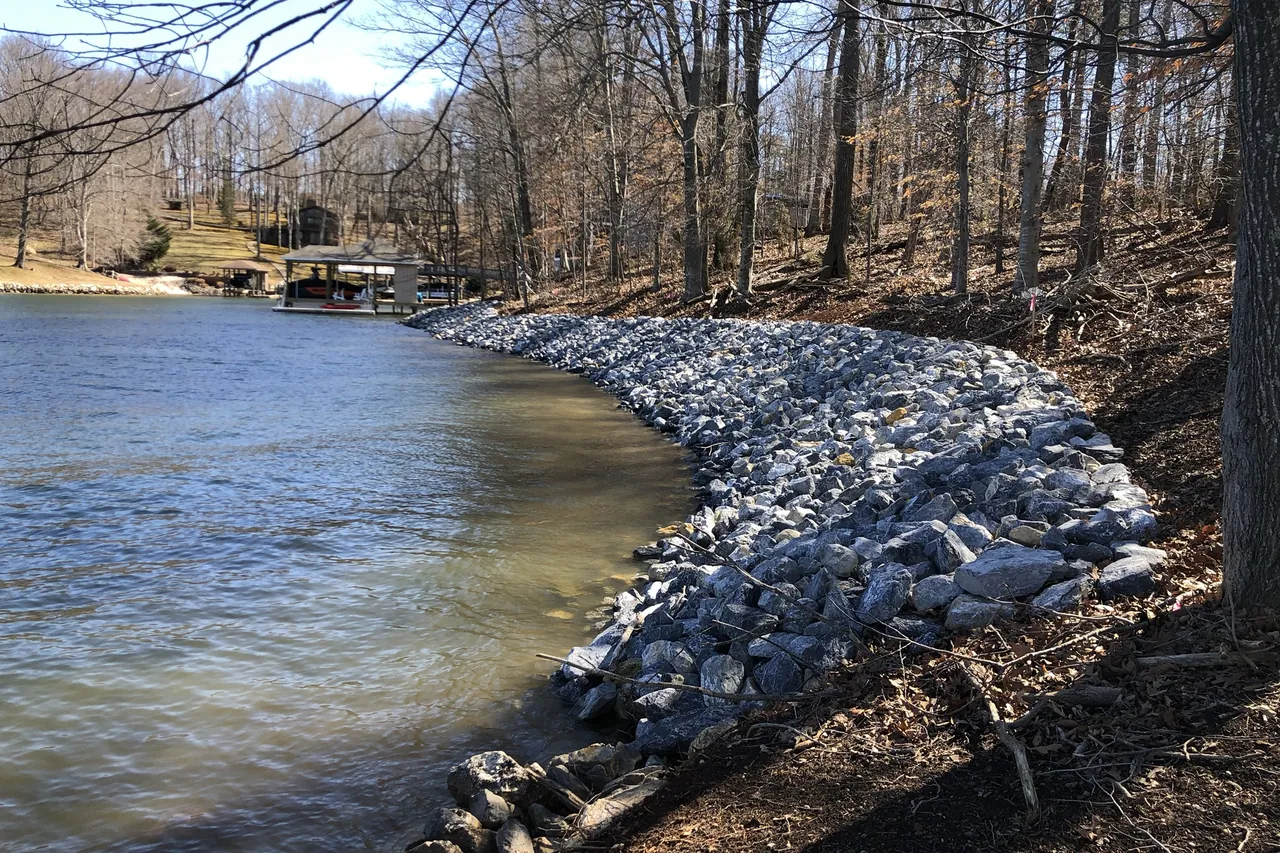
What AEP counts as active erosion
AEP's Shoreline Management Plan defines active erosion as areas that are bare and void of vegetation or other stabilizing material, areas being undercut or sloughing off the parent material, or areas right next to the shoreline that could deposit sediment or soil into the lake. That definition matters because riprap is generally considered only where it fits. A bank that's grassy and holding gets steered toward planting.
AEP has a baseline to compare against. For the original 2003 plan, the entire shorelines of Smith Mountain and Leesville lakes were surveyed by boat, and on land where needed, recording the type of erosion, land use, vegetative cover and any existing protection at each site, with photos and GPS positions. After you apply, AEP also visits the site itself.
What wears a lake bank down
- Waves. Virginia's Erosion and Sediment Control Handbook (Std. & Spec. 3.19) describes riprap on lake shorelines as protection "from the continual scour of wind-driven waves." AEP's 2003 shoreline survey recorded boat wakes and wind-driven waves where surveyors observed them.
- A waterline that moves. AEP's normal maximum operating level is 795.0 feet. The lake can swing up to 2 feet during a normal generation and pumpback cycle, can run lower when inflow is low, and in high inflow can rise to and occasionally over the 800-foot contour. In 2026 it sat about five feet below full pond for months. The part of the bank that meets the water isn't one fixed line.
- Water coming down from the yard. AEP's plan describes a vegetative buffer as the zone of trees, shrubs and other perennial plants that "intercept and filter stormwater runoff, stabilize the soil, and provide habitat for wildlife." A Virginia Cooperative Extension Master Gardener article on the lake association's buffer team describes landscaping's role in preventing "harmful runoff and erosion of the lake's shoreline."
- Losing the plants. AEP's FAQ says shoreline vegetation buffers the lake, improves water quality and prevents erosion. Minnesota's natural resources agency, in its lakeshore buffer guide, compares lawn grass roots of 2 to 3 inches with native grass roots of 3 to 5 feet, and lists vegetation clearing, foot traffic, and runoff down slopes and off hard surfaces among the causes of lakeshore erosion.
- A failing toe. Virginia DCR's stream stabilization guide warns that "toe scour can undermine the streambank and result in bank failure." It was written about streams, but the same concern is why AEP's riprap rules require the toe of the stone to be buried at least 12 inches.
Signs to check on your shoreline
Walk the bank and compare what you see with AEP's three categories:
- Bare ground between the lawn or woods and the water, with nothing growing and nothing holding the soil.
- An undercut, where the face is vertical or overhanging and soil is missing underneath.
- Sloughing, where chunks of bank have slid down the face to the waterline.
- Soil reaching the lake, such as a channel cut by runoff down to the water or bare soil right at the edge.
- Old riprap that has slid or thinned, leaving soil showing between or above the stones.
- Paths, stairs or downspouts that send water straight down the bank.
Take photos from the same spots each season and note the lake level that day. If in-water work ends up in the April 15 to June 15 window, AEP's plan calls for site photographs anyway.
When the lake is down, look at the lower bank
With the lake about five feet below full pond for months in 2026, WDBJ7 reported in July that the drought had exposed areas that are normally under water. A lower lake is the time to see whether the base of your bank is undercut and whether old riprap still reaches down to where it should. The exposed ground is still inside the Project boundary, though, so AEP's permit rules apply to anything beyond routine maintenance. Low water covers what you can and can't do while it's exposed.
The fixes, in AEP's order
AEP's FAQ says shoreline stabilization needs a permit and asks owners to consider vegetation first, then bioengineering, and hard armoring like riprap last.
- Vegetation. A planted buffer between the lawn and the water. AEP encourages keeping one, and its FAQ points owners to the Smith Mountain Lake Association's BLAST team for buffer landscaping advice. Extension's Master Gardener program describes those volunteers using native plants "to slow and filter water flowing into the lake." Ask AEP Shoreline Management whether your planting plan needs a permit before you start.
- Bioengineering. Plants combined with structure. Virginia DCR's stream stabilization guide lists live stakes, live fascines and brush mattresses among its bank stabilization practices, along with rock toe revetment. Those were written for streams, so ask AEP which approaches it will accept on the lake.
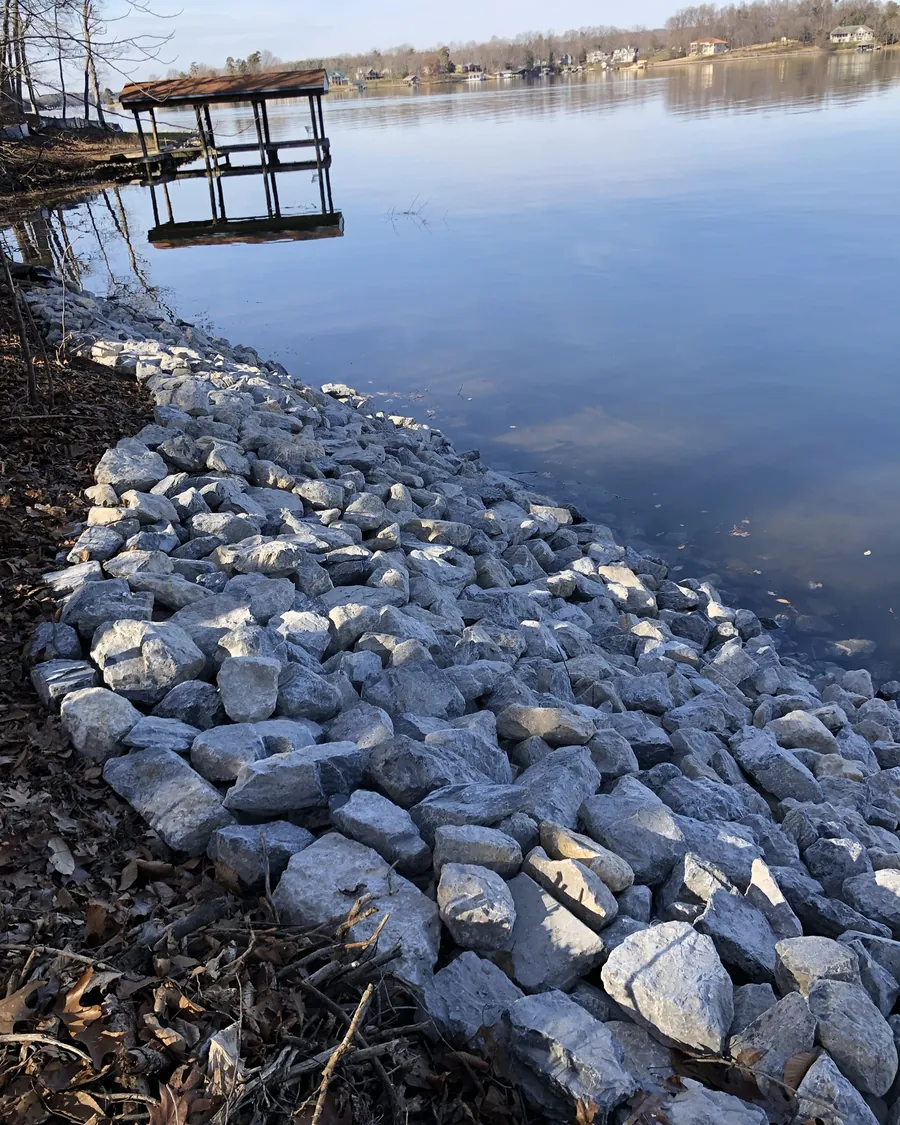
- Riprap. Where erosion is active, stone may be allowed with permits from AEP and the Army Corps: VDOT Class I stone, a finished slope no steeper than 2:1, and a toe buried at least 12 inches. The riprap guide has the full specs and permit order.
Two common ideas aren't on the list. New bulkheads are prohibited unless FERC grants a variance (see seawalls and bulkheads), and new beaches are prohibited, with no sand allowed below 795 feet.
Moves that break the rules
Some quick fixes for an eroding bank run straight into AEP's plan. Check before doing any of these:
- Cutting back the bank vegetation. Without a permit, AEP allows removing plants under half an inch in diameter, pruning but not topping, and thinning or limbing up to 20% of the canopy or 14 feet, whichever is less.
- Mowing down to the water. Lawns cleared before August 31, 2003 may generally be maintained. AEP encourages a planted buffer between the lawn and the shoreline.
- Pulling fallen trees out of the water. AEP discourages removing woody debris unless it's a hazard.
- Dumping fill or junk on the bank. Tires, scrap metal, crushed block and other unsightly material are prohibited, and so is anything placed in wetlands.
- Topping off old riprap. Rearranging existing stone within its original footprint is maintenance. Adding stone needs AEP and Corps permits.
- Piping runoff straight to the lake. Stormwater structures can't discharge directly into the Project boundary and have to sit above 800 feet.
Permits, timing and who does the work
Stabilization goes through AEP Shoreline Management (540-985-2579), riprap also through the Army Corps, and then the county erosion-and-sediment permit. Bedford County requires a Land Disturbing Permit for disturbance within 200 feet of a body of water at any size; Franklin County's local rule applies at 3,000 square feet within 200 feet of surface water. In-water construction is prohibited from February 15 to June 15 in certain shoreline zones. The permits guide has the details.
On licensing, Virginia's Landscape Service Contracting specialty covers altering a land area by excavation, clearing and grading, and Marine Facility Contracting covers structures that "impede, or alter a body of surface water." Ask any contractor which classification covers your job and check it on DPOR License Lookup. Contractors are responsible for their own licensing, insurance, permits, pricing and warranties.
Erosion questions
Is my bank eroding badly enough for riprap?
Compare it with AEP's three-part definition: bare, undercut or sloughing, or likely to put soil in the lake. AEP makes the call after its site visit, and a contractor's opinion doesn't substitute for that.
Can a contractor fix erosion with plants alone?
It's AEP's first choice. AEP's order moves on to bioengineering and then stone where planting isn't enough, so ask AEP and the contractor which step fits your shoreline.
Does replanting an eroded bank need a permit?
AEP's FAQ says shoreline stabilization needs a permit, and it lists vegetation as one stabilization method. Check with Shoreline Management at 540-985-2579 or shorelinemanagement@aep.com before planting as an erosion fix.
Can a contractor fill in the part of my yard that washed away?
Not freely. Inside the Project boundary, work can't change the Project boundary, and stabilization uses no more material than erosion control needs. Grading above the 800-foot contour falls under the county's land-disturbance rules.
Will riprap stop erosion caused by runoff?
Riprap protects the bank from waves. Water running down from the yard has to be dealt with uphill, through plantings, paths and drainage, and any stormwater structure has to sit above 800 feet.
How this site helps
Call (540) 410-1330 or send a request describing the bank, and we'll connect you with one independent local contractor who works on the lake. They look at the bank and put a price in writing. The referral is free.
Related pages
Sources
- Appalachian Power, Smith Mountain Project shoreline FAQ
- AEP Shoreline Management Plan (2025): Secs. 1.4 and 2.1.2, glossary
- Virginia Erosion and Sediment Control Handbook, Std. & Spec. 3.19 Riprap
- Virginia DCR, Stream Restoration & Stabilization Best Management Practices Guide (2004)
- Virginia Cooperative Extension Master Gardener program, "Buffer Landscaping"
- Smith Mountain Lake Association, buffer landscaping
- Minnesota DNR, Shoreline Alterations: Natural Buffers and Lakescaping (rev. 2012)
- WSET, October 13, 2026 and WDBJ7, July 13, 2026 lake level reports
- Bedford County and Franklin County land-disturbance rules
Bank losing ground?
Get one independent local contractor out to look at it. The referral is free.