Riprap & Dock Work in Huddleston, VA
If your lake lot is in Huddleston, it sits on the Bedford County shore of Smith Mountain Lake, near the state park and the dam. Riprap, dock repair, a new dock or a boat lift here goes through Appalachian Power (AEP) and then Bedford County, whose land-disturbing rule reaches any digging or grading within 200 feet of the water. This page covers where Huddleston fits on the lake, the Bedford permits, the $48 fee to record your AEP permit, and what the work costs.
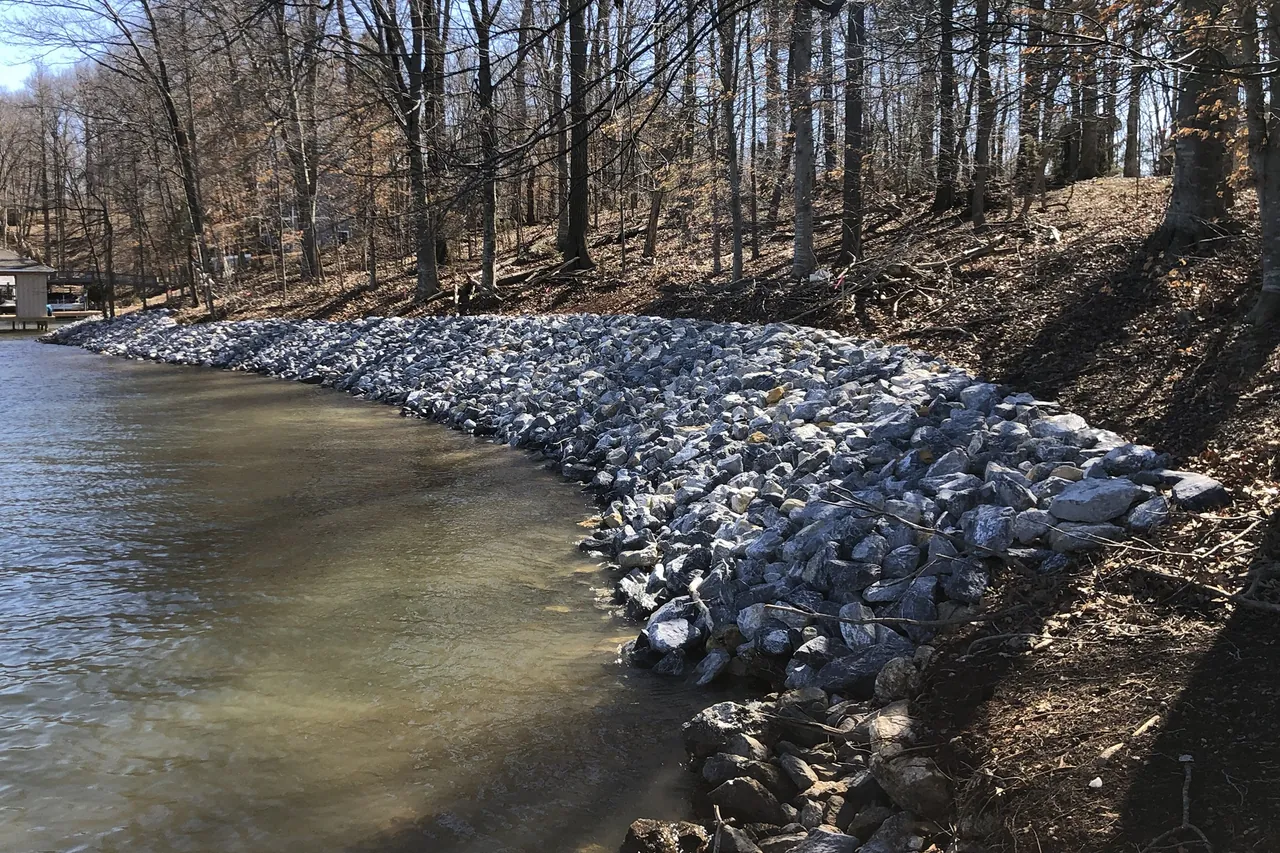
Huddleston at a glance
- County
- Bedford County, which holds the entire north shore of the lake
- Nearby
- Smith Mountain Lake State Park to the south; AEP's Smith Mountain Dam to the southeast
- Shoreline permits
- AEP for docks, lifts and riprap; the U.S. Army Corps of Engineers as well for riprap
- Land disturbance
- Bedford Land Disturbing Permit for any disturbance within 200 ft of the water, whatever its size
- Recording fee
- $48 to the Bedford County Circuit Court Clerk; AEP itself charges nothing
- County office
- Bedford County Community Development, 122 East Main St., Suite G-03, Bedford; (540) 586-7616
Where Huddleston sits on the lake
Huddleston is a Bedford County community along State Route 626, about 12.5 miles south-southeast of the town of Bedford. The whole north shore of Smith Mountain Lake belongs to Bedford County, with the Roanoke River channel dividing it from Franklin County, so a Huddleston waterfront lot answers to Bedford for county permits.
Two landmarks frame the area. Smith Mountain Lake State Park, run by the Virginia Department of Conservation and Recreation, covers 1,248 acres on the north shore and has a Huddleston address, 1235 State Park Rd. AEP's Smith Mountain Dam is southeast of the community, and the small slice of the lake in Pittsylvania County includes the dam access. What sets your rules is the county that taxes your parcel; Pittsylvania's very different trigger is on the Penhook page.
Bedford County's 200-foot rule
Bedford County requires a Land Disturbing Permit when disturbance exceeds 10,000 square feet, or when it happens within 200 feet of a body of water, regardless of size. Riprap goes in at the waterline, so a riprap job on a Huddleston lot is inside that 200 feet from the start.
Here's the arithmetic on one bank. Say 120 feet of shoreline needs stone and the equipment works a strip about 10 feet deep: 1,200 square feet, nowhere near 10,000, and the permit still applies because of where the work is. Disturbing an acre or more adds state VPDES construction stormwater coverage.
Order matters too: AEP's stabilization application says to get the county erosion and sediment permit after AEP issues its own, then send the approved county permit to AEP. Controls go in before clearing, and bare soil must be stabilized within 7 days of final grade.
What AEP and the Corps want before stone goes down
Below the 800-foot contour, AEP wants vegetation tried first, then bioengineering, and allows hard armor such as riprap only where erosion is active: bare ground, undercut or sloughing banks, or spots that could send sediment into the lake. A U.S. Army Corps of Engineers permit, applied for online through the Corps' Regulatory Request System, has to be issued before AEP authorizes the work.
- Clean, solid rock no smaller than VDOT Class I: 50 to 150 pounds a stone, at least 60 percent of it over 100 pounds.
- A finished slope no steeper than 2:1, with the toe buried at least 12 inches.
- Trees cut for the work bundled and sunk along the nearby shoreline in water 15 feet deep or less.
Every owner of record signs the application; a contractor can be listed but can't sign for you. The riprap page and the permits guide walk through the full process.
Docks and lifts: Bedford's permit and AEP's
Bedford County's building permit application carries a dock disclaimer: AEP runs its own dock permitting on Smith Mountain and Leesville lakes, a Bedford building permit "is not a substitute for an AEP permit," and owners are strongly encouraged to consult AEP before construction. A July 2017 WSLS report described Bedford supervisors dropping the requirement for AEP's sign-off before the county issues a dock building permit, with AEP still setting the dock's size and distances. State law (Va. Code § 15.2-1226) lets the lake counties regulate the location, size and length of docks below the 800-foot contour, as long as they don't conflict with the building code or AEP's federal license.
On AEP's side, a single-family lot with 100 to 300 feet of shoreline can have up to 1,500 square feet of dock and two slips, reaching no more than a third of the cove's width or 100 feet, whichever is less. The application asks for a licensed surveyor's drawing, the approved county permits and a check for the $48 Bedford recording fee, and the dock must be finished within two years. Any new or expanded PWC lift needs AEP approval. For wiring, a USBC dock guide covering the lake counties says sub-panel equipment grounds go to a ground rod on shore. See new docks, dock repair and boat lifts.
What the work costs
No one publishes Huddleston prices, so these are labeled national figures. Angi's 2025 data puts riprap at $70 to $400 per linear foot installed; for the 120-foot bank above, that's $8,400 to $48,000, with steep, wooded or wave-exposed banks toward the top. HomeAdvisor's 2025 average for dock repair is $3,201, and Fixr's January 2025 range for a boat lift is $2,000 to $20,000. Plan around a written quote for your lot; the cost guide breaks the figures down.
Huddleston shoreline and dock questions
Does a contractor need permits to reset riprap that has slumped?
Not from AEP, if the job only rearranges the existing stone within its original length, width and height. Adding stone needs AEP and Corps permits. Because Bedford's rule applies within 200 feet of the water at any size, ask the county whether the reset moves enough soil to need its permit.
Can the contractor sign the AEP application for me?
No. AEP requires the signature of every owner of record and returns incomplete applications. The contractor can be named on the form, and AEP visits the site after the application comes in.
Is a Bedford building permit enough for a contractor to start a dock?
No. Each says it doesn't replace the other: a new dock needs Bedford's building permit and AEP's Occupancy and Use Permit.
When can a contractor work in the water near Huddleston?
In areas AEP classifies as Conservation/Environmental or Impact Minimization Zones, in-water construction is barred from February 15 to June 15. In-water work from April 15 to June 15 also needs extra information about largemouth bass nests, and a nest can delay or change the job.
How this site helps
Call (540) 410-1330 and we'll connect you with one independent local contractor who works on the lake. They can look at the bank, dock or lift and price it; hiring them is up to you. Contractors are responsible for their own licensing, insurance, permits, pricing and warranties, so look up any license on DPOR's License Lookup and read how to hire for questions to ask.
Related pages
- Riprap rules, stone and permits
- AEP, Corps and county permits
- What riprap and docks cost
- Dock repair
- New docks and boathouses
- Boat and PWC lifts
Other lake communities
Sources
- AEP Smith Mountain shoreline FAQ
- AEP Shoreline Stabilization Permit application (updated 5/21/2026)
- AEP Occupancy and Use Permit application, low density single-family (updated 7/31/2026)
- AEP Shoreline Management Plan, approved February 18, 2025
- Bedford County residential land disturbance
- Bedford County building permit application disclaimers (dock disclaimer)
- Bedford County Building Inspections, residential projects
- WSLS, July 11, 2017: Bedford supervisors change SML dock permit process
- USBC Dock Requirements Guide (posted by Franklin County Building Inspections)
- Va. Code § 15.2-1226
- Virginia DCR: Smith Mountain Lake State Park
- Wikipedia: Huddleston, Virginia and Smith Mountain Lake
- Costs: Angi riprap cost (2025 data), HomeAdvisor dock repair (2025), Fixr (January 2025)
Have a Huddleston bank or dock that needs work?
Describe the shoreline or dock by phone or through the quote form, and we'll put you in touch with one independent local contractor.